Moments That Matter

What happened on this date in Mets history? Or, at least, January 28th?  Well, a number of things did.

On this date in 1972, Tsuyoshi Shinjo was born. In two seasons with the Mets, Shinjo would go on to bat .251 with 11 home runs.

On this date in 1967, the Mets drafted Ken Singleton. He played two seasons with the Mets, batting .252 with 18 home runs.

On this date in 2004, the Mets signed Todd Zeile. In the final season of his career, Zeile would bat .233 with nine home runs, before receiving one last well-deserved ovation, shaking hands with Angel Hernandez, and riding off into the sunset.

And finally, on this date in 2010, the Mets signed Valentino Pascucci to a minor league contract. He appeared in ten games with the Mets, all in 2011, and batted .273.

In the annals of Mets history, Valentino Pascucci, and indeed, all of 2011, is often overlooked. What is there to remember? David Wright batted .254. Carlos Beltran was okay in 98 games before being traded to the Giants. The Mets went 77-85, 4th in the N.L. East. But on September 24th of that year, it didn’t matter: R.A. Dickey was pitching, Jose Reyes was chasing a batting title, and I was in attendance. Everything was good.

That changed quite quickly, however, as it has a penchant to do around the Mets: Dickey was brilliant as usual – he carried a one-hitter into the 7th, and only gave up one run – but the Mets of the early Collins administration, as was their custom, were held scoreless by Cole Hamels as well. After the Phillies scored in the top of the 7th, the Mets came up, looking to tie the game with Willie Harris, Mike Nickeas, and Jason Pridie. The first two made outs, and Terry, apparently attempting to halt the somewhat negative trend, sent up Valentino Pascucci to pinch-hit.

I sat on the field level up the first-base side, and watching Pascucci in the on-deck circle, I was struck by the sight of the bat in his hand: Pascucci swung his club like a twig, with a violent, unapologetic uppercut. As we know now, this was nothing if not foreshadowing: Pascucci clubbed the 2nd pitch he saw from Hamels about a mile deep into the left field stands, and the game was tied.

The Mets would score the winning run on what was, for the time, a much more common sight, a David Wright RBI double. As Citi Field emptied, however, no one was talking about the slump-mired not-yet-captain. We were discussing Valentino Pascucci, and his unilateral unabashed awesomeness.

No one talks about the Valentino Pascucci home run anymore. I don’t know why. I suppose most people will chalk it up to the fact that 2011 was anything but a memorable season, but that doesn’t exclude single games from memory: just about no one remembers the intricacies of 1996, but we still talk about the Dave Mlicki game, don’t we? Some will also say that we don’t talk about 2011 because we didn’t win anything that year, but don’t we reminisce about Endy’s miraculous grab? We didn’t win anything in 2006 – in fact, Endy’s play came merely three innings before we were literally eliminated from winning anything – but the moment remains eternal. You might say that Pascucci’s blast – it deserves a name worthy of a legend, so that’s what I’m going to call it – is hardly special among Mets moments, but I would disagree: how many times can we remember that a 32-year-old journeyman pinch-hit against a rival ace, and at a key point in the game, tied the game with his first Major League home run in eight years? Can you look me in the eye and tell me that that falls short of the required criteria of “special?”

So I say let’s remember it: let’s remember Pascucci’s blast. As Mets fans, special moments, especially in recent years, are few and far between, and we’d be foolish to let one so worthy of being remembered go to waste.

So here’s to you, Val Pascucci. Five years ago you joined our team; and on September 24th, 2011, in the midst of a season to forget, you gave us a moment to remember.

Standard

George Foster Made A Scoreboard Okay

One can’t help but wonder, these days, whether the things people have the gall to complain about – for example, credits cards taking too long to process – would have been quite so contentious in a different time; before technology made everything instantaneous and before twitter allowed bloggers to exchange projections so quickly that by the time the season began, fans already knew how it was going to end.

With the Mets, many of the problems currently being incessantly grumbled about do, in fact, deserve to be discussed, and ultimately denounced: Fred Wilpon being named head of the MLB finance committee, for example, seems a pretty good indication that Rob Manfred will take the same tack as his predecessor when it comes to monitoring the Wilpons’ financial abilities. Similarly, the Mets recent announcement that ticket sales project to increase by 19% seems to be less truth and more like equal parts exaggeration, attempt to avoid a lawsuit, and naïve self-deceit, because despite certain well-known promises, the payroll does not seem to be rising with the numbers of fans in the seats.

However, at a certain point, complaining becomes more of a chore than enduring the thing you’re complaining about. For me, that point, or at least a point that illustrates my point, came in 1982.

1982, devoid of context besides what the Mets did that year, really does not stand out. The Mets entered the season after a strike-shortened 1981 in which they’d gone a combined 41-62. They started off 27-21, before going 38-76 the rest of the way, including a 14 game losing streak from August 17th – 31st.

Fans had a lot to complain about in 1982: George Foster, the big new acquisition who was going to take the NL East by storm, hit 13 home runs. Dave Kingman batted .204. The highest OPS of a starter was John Stearns’ .764 – and he only played 98 games. It was, to be sure, not a good year. But there was one thing that no one complained about: Diamond Vision.

Diamond Vision, the high definition, for the time, video scoreboard, debuted in 1982, and although unimpressive compared to today’s video boards, 1982 Mets fans were satisfied: attendance increased by almost 620,000, albeit from an all-time low. The team on the field was no good, but Diamond Vision made it more interesting to watch. Which brings us back to today.

Despite a plethora of mostly-deserved grumbling directed at the Wilpons for spending an estimated $8 million on a new scoreboard without upgrading at shortstop (although, as we’ve previously covered, the free-agent shortstop market was nowhere near as deep as the trade market, suggesting that the lack of a replacement for Wilmer Flores is more due to an unwillingness to part with prospects), I find it hard to believe (although around the Mets – I can’t stress this part enough – you just never know), that the $8 million spent on upgrading the scoreboard and facing of the second level in the outfield – which I, for one, fully support – is $8 million removed from the player spending budget. The Wilpons have plenty of cash, and if you want to complain that they’re not spending enough of it on players, by all means be my guest. But please, recognize that the money spent on the scoreboard was not the last precious pennies in the Wilpons’ now empty bank vault. The Wilpons have plenty of money to spend: spending on a scoreboard and declining to spend on players are completely unrelated. There’s more where that came from: it’s just a matter of whether they ever decide to spend it.

So complain about thriftiness all you want. Bash the Wilpons for their shifty finances with my most sincere blessing. But I think it’s plain to see that some things just don’t need to be complained about, and a brand new scoreboard is one of them.

Standard

Ode To The Offseason

‘Twas a night in midwinter,

And all through the house,

Not a creature was stirring,

Not even a mouse

When all of a sudden,

Lying asleep,

I heard a strange sound,

Barely more than a peep

Waking from slumber,

I searched for the source,

I reached for my phone,

As a matter of course

In fact, it was ringing:

Not loudly at all,

I read the display,

Then I answered the call

A voice spoke to me,

A man I did not know,

With no introduction,

He let the words flow

“The season approaches,”

He said at the start,

“And although you deny it,

There’s doubt in your heart.”

“You sit there and think,

That we may not win.

Let me promise you this:

We’ll be more than we’ve been.”

“We’ve got solid young pitching,

And yes, even more:

Our GM has developed

An outstanding core.”

“Our lineup is youthful,

Our bullpen is primed;

You may not believe it,

But this is our time.”

I thought for a moment,

Then spoke to the man.

“I hope you’re not selling,

A new ticket plan.”

He laughed at that one,

Then spoke again,

“Please, pay your attention,

And I won’t pretend.”

“I’m not selling or buying,

Nor running a scam,

I’m here to remove you,

From your mental jam.”

“Mets fans are loyal,

That’s always been clear.

Now we want you to know,

That there’s no need to fear.”

“I can tell you this,

From the depths of my heart,

We’re primed for October,

Straight from the start.”

In sudden silence,

The phone line was dead,

And I sat bewildered,

Alone on my bed

Had that been the truth?

Were my Mets really there?

Could they get to October?

And breathe playoff air?

Thus quite bewildered,

I fell into sleep,

Some hours later,

My alarm clock beeped

According to habit,

My first move of the dawn,

Was to open Safari

To metsblog.com

I saw the first item,

My heart gave a lurch,

It said, “Still no news,

In the Mets shortstop search.”

So now who was right?

The man on the phone,

Had said seeds to victory

Were already sown

But now I’m being told

That there’s no shortstop present?

And none of our options,

Is particularly pleasant?

Well that doesn’t fit,

I silently opined,

We’ve got some young talent,

Who knows what we’ll find?

We’ve got Wilmer at short,

And he may yet be great,

So let’s give him a chance,

Let’s not get irate

My point to myself

Was that nobody knows,

We’ve all yet to experience

The highs and the lows

Not reporters, nor even

Duquette on TV

Knows what kind of hitter

Wilmer Flores will be

Nor do they know

How this team will contend,

With the season approaching

From right ‘round the bend

The dire predictions,

Disheartening news,

The stories that give us,

The Mets-induced blues

They have no affect

On the season for now,

All will be decided,

But no one knows how.

So my message to you,

As you reach the end,

It that negativity,

Is never your friend

We don’t know what will happen,

Nor in what way,

So can’t we just try

To be happy today?

The anger, the sadness,

The clamorous din,

At least can’t it wait

‘Til the season begins?

Standard

Welcome!

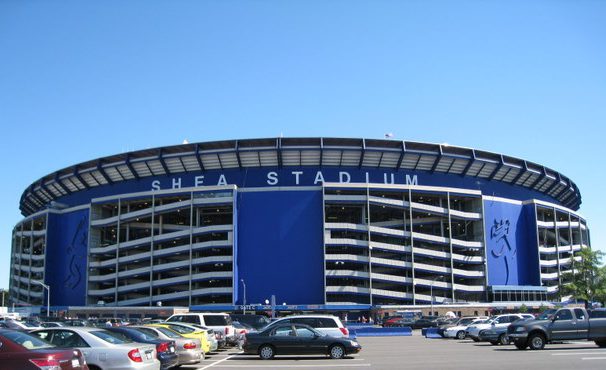
Welcome everyone, and welcome Mets fans especially, to the Shea Bridge Report.

Mets fans, as a group, are seen in society, as a general rule, as lunatics. We root for a group of perennial losers, and our boundless optimism is unnerving even to the most devoted optimists. But while polite society – which banned us long ago – sees this unending positivity as pure insanity, we know better. We understand the lessons that true Mets fans have learned.

Mets fans take a lot of flack for putting too much stock in the history of their team, but we give out an equal amount of flack to ownership for not honoring history enough. We stand at the farthest extreme on the spectrum of nostalgia – while most casual fans are happy to see clips of their team winning a World Series, we flock like crazy to the nearest TV screen any time any chance appears of seeing 30 seconds of highlights, whether it’s a World Series win or an inning of a game from May 2004. Here at the Shea Bridge Report, history will never lose its meaning – our namesake, or the namesake of our namesake, should show you how we value history. The present is where our attention is focused, but how can we look at Noah Syndergaard without comparing him to Tom Seaver, Pat Zachry, Doc Gooden, and Bill Pulcipher? We must remember the past, if only to know where the present is leading us.

In our lifelong exercise in futility, Mets fans have also learned another important lesson: the need, as the original Mets fan Tug McGraw put it, to believe. The majority of Mets teams have been and, if history is any indication, will be, mediocre or worse. But Mets fans have a unique ability to find the good in any – and I mean ANY – situation. At the end of 2014, we were certain that when 2015 began, an upgraded shortstop would have been acquired. When it became clear, however, that this was less likely than Jason Bay winning the 2015 NL M.V.P., what happened? Lesser fans would have complained; they would have grumbled about management, the front office, and anyone else within grumbling range. But we are not a lesser fan base; we’re Mets fans.

At the Shea Bridge Report, good and bad are subject to change, and nothing is ever over: prospects will always be one step away from becoming stars, grisly veterans will always have just enough for one last successful hurrah, and a four run deficit in the ninth inning will always be just a few runs short of a win. Mets fans are not rational, or logical, or anything of the sort: after experiencing the miracles of 1969, 1986, and 1999, as well as the more miserable moments in 1977, 1988, and 2007, we’ve seen too much that defies logic to put any faith in it. We take the bad with the good, and if we can, we come out smiling.

That’s not to say, of course, that we don’t differentiate between winning and losing: we do, perhaps more than anyone else. As Mets fans, we take every loss, every strikeout, and every robbed home run like a direct personal insult. When Ruben Tejada boots a double play ball and costs the Mets the game, we turn on him with ferocity unmatched. But just as quickly, we wake up the next morning and take to our various media outlets, expressing our sorrow at our vicious jibes, and our hope that the source of whatever discontent previously existed goes on to atone for his mistake by coming up big and getting the Mets a win. We will, from time to time, become angry: that, when you’re around the Mets, can’t be avoided. We take it personally just like everyone else. The Mets fan difference, however, lies in the fact that we, unlike other fan bases, can – and will – eventually swallow our anger, offer forgiveness, and continue rooting for our guys – the Mets, each and every one of them – with all our hearts.

So, if you find yourself in our description, consider yourself welcome here. If you booed Chris Young when he came to bat but cheered when he got that elusive hit, you’ll be right at home. If you find yourself experiencing rapidly shifting emotions directed at certain young athletes based on actions none of us could perform ourselves, come on in. If you take it more personally than anyone else, but you always manage to keep on believin’, the Shea Bridge Report is the place for you.

Lets Go Mets!

Standard