My Very Own Two Game Road Trip

The Mets will open the 2016 season with a two game road trip.  And I, with my own personal 2016 season, will do the same.

As I returned from Madison Square Garden, the Knicks’ win over the Celtic fresh on my mind but the 2016 Mets threatening Kristaps Porzingis for my undivided attention, I was suddenly fully occupied with Opening Weekend of 2016.  It was sudden, unexpected: all at once, I couldn’t think of anything but Saturday, April 9th, when I’ll finally get back to Citi Field.

And so, walking home from the subway only minutes after watching what by all accounts was a heart-pounding, adrenaline-pumping thriller of a win, a Mets fan who simply couldn’t wait any longer for baseball season began planning a trip.

Were Opening Day a night game, I’d make it, but it’s not, and I can’t.  But I won’t be far away though: come Friday, April 8th, when the Mets will take on the Phillies at 1:10, I’ll be A) in the midst of the three hour train ride from Providence to Penn Station, or B) finishing up Spanish class.  I haven’t decided yet, and I assure you that Opening Day won’t factor into my decisions at all.

Not that I’m winking as I say that, or anything.

In any case, as the Mets’ starter delivers Citi Field’s first pitch of the season (Syndergaard?  DeGrom?  Who knows, when we’ve got two games in five days to start the season?), I won’t be present, at least in any physical form.  But I’ll be close by, and rest assured I’ll be listening, one way or another.

Spanish class or not.

Regardless, I’ll be home by Friday night, and by that time, baseball in New York will be in full swing.  Some have questioned my priorities, spending a full weekend in New York to watch two baseball games, but if you don’t understand the way I prioritize things by now, it’s your job to get to know me better.

So I’ll get to New York, and whatever else I have to do will take a seat, because during baseball season, there’s no uncertainty as to what comes first.  And then finally, for the first time in what, I’m sure, will have felt like ten years, I’ll go through the standard pregame rituals: choosing a jersey checking the weather, evaluating StubHub offerings, etc.

And for what is mostly meddlesome, mildly inconvenient preparation, I’ll sure feel happy about it.

And then, after a sleepless night, it will be game day, and all the waiting, and anticipation, and fruitless speculation, and absolute monotony, which will already have been dissipating, to a degree, since Opening Night in Kansas City, will finally be ready to pay off in full.  And I’ll go through the motions, and make every attempt to pretend that sure, it’s just another day.  But everyone who knows me will know just how far from the truth that will be.

It will be the day I finally return to Citi Field, my second or third or whatever number home, on equal footing with all the others if not higher.  A World-Class ballpark that houses a World-Class team where World-Class memories have been made, with a pennant newly raised to commemorate the sheer volume of World-Classiness that Citi Field houses.

Repeat: you bet it won’t be a normal day.

I tell myself every offseason that I’ll remember the sensation of pulling ‘round the corner on the 7 train, and seeing the outline of Citi Field for the first time.  Every offseason I forget.  Maybe I’ll remember this season, but somehow, I think it’s more likely that I’ll forget, swept away in the euphoria.  But regardless, the sensation of finally returning will be, I’m sure, all that I’ve billed it.

And that’s how my season will begin, with a Saturday night game against the Phillies, which I’m feeling good about, because these are the Phillies and we’re the Mets and this is not 2007 but 2016 and we’ve got four aces and hitters to boot and they’ve got very little of anything.  We’re coming off a World Series run, and still will be the night of April 9th.  The Phillies?  Who are they?  We’ll take care of ‘em.  Harvey or Syndergaard or Matz or deGrom or even Bartolo Colón himself will do what they do, and six or seven scoreless innings and Reed and Familia later, we’ll have ourselves a win.

Saturday will end, and Sunday will begin, and I’m confident that against the Phillies, I’ll see another win, with all hands on deck and all machines humming.  Neil Walker will contribute, as will Asdrubal Cabrera, even though I didn’t like his signing, because I’ve just got some really good feelings about that opening weekend.  I don’t know particularly why this is: maybe that we just made a run to the World Series, maybe that the Phillies are bad and not getting better, maybe that the thought of having baseball to watch again makes me so damn giddy that I can’t help but think positively of it.

And that will be that.  With a two game road trip concluded, I’ll pack whatever I conspired to bring with me and catch a three hour train back to Providence, where school will resume in earnest and I’ll have a whole damn month before I can get off school and focus my attentions on the infinitely more desirable theater that will inevitably be playing out in Queens.  There will be highs and lows, injuries and triumphant returns, walk-offs and blowout losses, well played pitchers duels and sloppy slugfests that, at least, Keith Hernandez, we now know, will be back to grumble over.  But whatever it is, there will be baseball.

In the dead of winter, thoughts of Baseball overcame me, to the point that I buckled down and planned my first annual return to New York.  I really planned it – looked at trains and everything.  Few things are powerful enough to inspire that kind of compulsion – in fact, I can’t think of anything but this.  A return to baseball.  A return to summer.  A return to the suddenly homey grounds of Citi Field.

And after my two game road trip?  No, I won’t be back.  Not for a while, at least, with midterms and finals and projects and whatever else is dreamed up for us students to complete.  But it will be baseball season.  And with a nightly Mets game to look forward to, my month in captivity will pass in the blink of an eye, and I’ll be back in the seats before you know it.
Standard

Wherever Home May Be

Madison Square Garden is a nice building on its own, but it’s no Citi Field.

Yes, you read that correctly.  The perpetual drear offseason has me thinking about baseball in rose tinted glasses, and thinking of Citi Field, I suddenly find it less disappointing than I remember.

I watched the Knicks beat the Bucks last night.  It was a fine time, relative to the other options available on a January Sunday.  in four or five months, I doubt it.  But as offseason entertainment goes, Kristaps Porzingis and friends isn’t bad at all.

And then the game ended with a win, and the crowd slowly descended the stairs.  And that’s when Citi Field came to my mind.  The stairs at Madison Square Garden, the World’s most famous arena, are cramped, dingy, and airless.  They go on forever, and there are no windows to speak of.

I remembered descending the stairs at Citi Field after a win, a cool breeze blowing in from the parking lot, the Manhattan skyline visible beyond Queens, the smells of the game coming off the field, the postgame show playing over the speakers over the rotunda.  And I may be romanticizing, but if I am, I don’t think it’s the only thing.

We, the fans, were disappointed when Citi Field opened in 2009.  It didn’t honor Mets history.  Its outfield dimensions were ridiculous.  A seemingly random assortment of seats had glass panes in the way of the field.  And these were all very legitimate criticisms, but not enough to make Citi Field a bad place to watch a ballgame.  We deluded ourselves into thinking that they did, because there was so much wrong with Citi Field that it just had to be bad.  But although we didn’t immediately allow ourselves to see it, there was some good to be found.

The main attraction of Citi Field, as it went through construction, was that it was a world class ballpark.  That’s all we heard.  “When World-Class Citi Field opens in 2009,” or “This virtual tour of the Mets new world-class Citi Field, is brought to you by…”  For the most part, the world-class designation was ignored as Citi Field opened.  For one thing, no one knew exactly what it meant, and for another, the negatives were so numerous that whatever “world class” meant, we were sure it wasn’t enough.

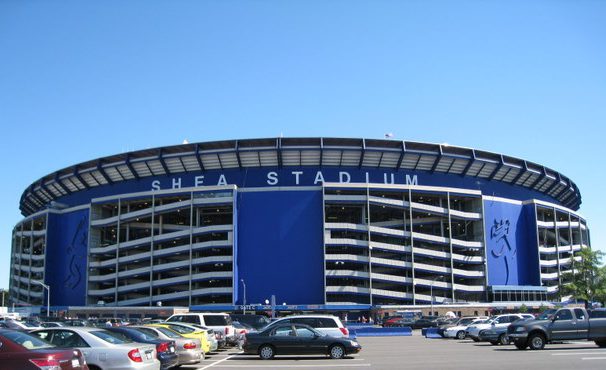
The negatives to Citi Field, when it comes down to it, are that Citi Field is not Shea Stadium.  Many of us didn’t want to see Shea Stadium go, and when it did, nothing could have been enough.  And because of it, those who had hated to see Shea go allowed themselves to turn against a very pleasant, if not historical, ballpark.

I myself was sad to see Shea go, and I don’t deny that Citi Field has its share, or perhaps more, of drawbacks.  But Shea’s not coming back, and although I myself refused to accept that for the longest time, it’s time now to acknowledge both ballparks for what they were.

Shea was our childhood home.  It was that old house with the leaks in the basement and the kitchen too small for the family to eat in, but we loved it because it was ours, and because of the experiences that came with it.  It had an internal color scheme that we loved, and an exterior that, while maybe not the most beautiful thing in the world, was unique, and we loved it for that.

Citi Field is the new place in the fancy new neighborhood.  We didn’t like it when we moved in, almost on principle.  The slick new construction didn’t look anything like the old place that we were used to, and on the inside, everything was a dull shade of green.  We didn’t like the new place because it wasn’t the old place.  But as we critiqued everything that it wasn’t, we forgot to celebrate what it was.

Just think about all the good things about Citi Field.  Unlike Shea, it’s got plenty of space, all open to the outdoors, like baseball is supposed to be.  It’s got better food.  The views are better, as are the bathrooms and the clubs.  Citi Field has the plaza in center field, which we’ve taken for granted, but there was nothing of the sort at Shea.

No, Citi Field is not Shea, and it never will be.  It’s lacking in some ways, compared to Shea, and in others, much as we hate to admit it, Citi Field is Shea’s better.  And Citi Field has one thing that Shea, regrettably, no longer does: it’s home now.  If we’re honest, it’s been home, by letter if not by spirit, since 2009, but after the magical summer of ’15, Citi Field no longer faces a dearth of Mets memories.  And if we’re once again honest, that was the last thing holding it back.

When there was nothing left to complain about, we complained that Citi Field just hadn’t seen enough Mets history.  As if it was somehow the ballpark’s fault that it’s early years were populated by the Mets of the Manual and early Collins administrations, which didn’t yield any results of note until this past year.  Citi Field had seen a no-hitter, and that’s about it.  But even before 2015, things had begun to change.  After the final weekend of 2014 turned into the weekend of Lucas Duda, it seemed to crystalize in our minds that Shea would not be back, and that we were perhaps better off celebrating what we had.  Some resisted, but others acquiesced.

And then 2015 happened, and Citi Field finally saw what some marketing employees termed “Mets Magic” a few years back.  Our ballpark saw Wilmer Flores night, the sweep of the Nationals and subsequent movement into first place, the arrival of Cespedes, the terror of the four horseman rotation that was completed when Steven Matz had the best Mets debut of all time, seven playoff games and four wins, and the raising of our first brand new pennant in 15 years.  And, of course, Citi Field saw the World Series end, not in our favor, and there’s nothing that brings people together like heartbreak.

And now Citi Field has seen at least a fair share of Mets history for its relatively brief lifespan, and with that, the last major obstacle to full acceptance as Mets fans’ new home has vanished, for all but the most staunch Shea Stadium worshipers.  Not that these people are crazy, or anything like that: for the longest time, I was one of them, and even still, Shea holds an allure that I don’t think Citi Field will ever replace.  But Citi Field has turned a corner in my mind.  Before, I was reluctant, but Citi Field has won my favor.  Citi Field is home now.

This all started with a trip to Madison Square Garden, and a realization that Citi Field had nicer stairs.  That segued into a reflection on how nice it is for a stadium to have the amount of open, outdoor space that Citi Field does, and from there, my thoughts were off and running.

I don’t know if Citi Field deserves quite so many words right now; it’s not like the stadium is changing, and we won’t be back inside for three months at least.  But I think Citi Field has put up with enough, and is just now getting its due as a ballpark that is comfortable, well designed, and fun to attend, if not a carbon copy of Shea Stadium.  Citi Field is a heck of a ballpark, as well as now being our home, and I hope I’m not the last to finally acknowledge it as such, but even more than that, I’m glad that Citi Field is finally taking its rightful place as the home of some recent memories of Mets magic, and with that, winning over the hearts of fans who held out reluctantly for so long.

But even more than that, I just can’t wait to get back there.

Standard

Moving On (Up?)

Prelude: I wrote this the day of Game 5, hours before our season ended.  I wanted to have something to post if we lost.  Of course, we did lose, but we lost in such a manner that I immediately knew this would not be enough, so I wrote something else.  Now, however, the notion of moving on is in the air once again, as the first pictures of Daniel Murphy in his Nationals gear have surfaced.  It’s painful to see, but as I say, 2015 is over, and we’ve got to look ahead to bigger and better things.

So here it is: The Lost Post, you could call it.  Written during the World Series and still relevant today, I hope you enjoy.

———————————-

As the satisfyingly not-bad season of 2005 came to a close, I began slipping into a routine.

Most days, the Mets would play a night game, and I was at that happy point in life when you’ve got limited ability to make choices, and extremely limited factors (read: homework) that can take up the time otherwise used for free choice.  I would watch an inning or two of the Mets most nights, before heading off to my room for bed.

Well, ostensibly for bed, really.  Secure in my room, I’d turn out the lights, cover myself with the blanket, and turn on my radio.  I’d just recently gotten the radio as a gift.  I still have it today.  Some things just don’t go away.

With the radio on, muffling the sound in my pillow, I’d listen on the fan as Gary Cohen, Howie Rose, and Ed Coleman called the action.  As that reassuring 83-79 season wound down, and everyone expected more the next year, I was hooked.

In 2006, I listened to every moment that I could.  I was listening as Wagner shut the door and the Mets clinched the East.  I’d been listening a few days before, when Aaron Heilman had given up a walk-off double to Ronny Paulino, and prevented the Mets from clinching.  And I would listen as game seven unraveled, and the Mets came up one swing short of a pennant.

As much as I loved listening to the games, however, the evening was never complete until a long while after.  Immediately at the end of every game, they would go to commercial, and when they returned, Howie would read the production credits.  It wasn’t by coincidence that I had the entire WFAN Mets production staff memorized that year, led – of course – by our producer engineer in the booth, the immortal Chris Majkowski.  I heard it every night.  After the credits, they would go to commercial again, and when they returned, you’d hear the opening notes of Meet the Mets.

Not any old Meet the Mets, though: it was some special, funky, jazzed-up version that, to my nine year old self, was unbelievably cool.  Howie would come back on, welcome us all to Mets Extra!, and then recap the game.  He’d go through the out of town scoreboard, and sometimes go down to Ed Coleman for the postgame interview.  Then they’d go to commercial, but not before playing the defensive call of the game, which you knew meant the highlights were coming up.

Sure enough, after the break, Howie would come back, and take us faithful listeners back through the game, playing the calls as he summarized.  This was key even when I wasn’t hidden under my blanket: driving home from games, stuck in postgame traffic, I’d always push to hear the highlights on the radio, and was often, although not always, when my mom couldn’t take any more noise, obliged.

Howie would finish up the highlights, read out the next day’s opponent, game time, and starting pitchers, and bid us goodnight.  I would turn off my radio and head to sleep, already pondering the upcoming match up.

I fell into that routine in 2006, and for years, it was easy to maintain.  I couldn’t listen when I was away during the summer, but for the four months or so that I was home, just about every night would end with Mets Extra!.  The radio’s batteries needed changing occasionally, but other than that, not much changed.

Then, early in the 2013 offseason, rumors emerged that the team was considering splitting from WFAN after the season.  I was unnerved, although I didn’t think the rumors would come to anything: the Fan without the Mets?  Impossible!  That couldn’t happen.

It did, though: WFAN wanted the higher-in-demand Yankees, and the Mets would be shunted sideways onto WOR.  There was no word on which, if any, broadcasters would be retained, or how the programming would change: all we knew was that our games would be aired on the station that also carried Rush Limbaugh and Sean Hannity.

The 2013 season slid by at the same 74-88 pace as 2012, and all seemed as usual.  The Mets had 73 wins on the last day of the season, and had a chance to equal their win output from the previous season.  It was also Mike Piazza Day: he was being inducted into the Mets Hall of Fame, and the pregame on-field ceremony was being carried on WFAN and emceed by, who else, Howie Rose.

Howie did his bit, the game began, and the action unfolded.  In the bottom of the first, Eric Young singled, stole second, stole third, and scored on a David Wright sac fly.  In the top of the fourth, Niese gave up two runs – he should have given up more, but he made it out of the inning despite allowing hits to five of the six batters he faced – and the Mets were down a run.  Then in the bottom of the eighth, you had your classic 2013 Mets inning.  Lagares, Juan Centeno, Wilfredo Tovar, Josh Satin, Eric Young Jr., and Justin Turner.  Reach-on-error, bunt single/Lagares scores-on-error, sacrifice to move runner to third with no out recorded because of defensive miscue, flyout, den Dekker scores on groundout, groundout to end the inning.

Honestly, it’s a wonder we won 74 games that year.

Frank Francisco came on in the ninth to save it.  Francisco, otherwise an unmitigated disappointment, shut the Brewers down with two strikeouts, thereby bookending his two-year Mets tenure with saves of one-run leads.  Ah, the things one remembers.

Howie and Ed Coleman came on for the postgame, and in honor of the final Mets game on WFAN, gave a brief tribute.  I didn’t pay much attention: being a Sunday, the Jets were probably playing, and the Mets season was over.

And then, before I knew it, the 2014 season began, and one thing was painfully obvious.  There was no more Mets Extra!.  WOR, the Mets new home, had opted instead for a postgame show with Seth Everett, who, while certainly not a bad guy himself, was no Howie Rose.

Quite honestly, listening to the Mets just isn’t the same without Mets extra.  No postgame show has matched it, either in terms of nostalgic value or pure content.  Maybe WOR will come to its senses in the future and bring Mets Extra! postgame back: I doubt it, but it could happen.  If it doesn’t, however, we’ve just got to accept it.  Mets Extra! is gone.  It’s not as much fun without it, and we’ll always wish we had it back, but it’s almost certainly not happening.

Which brings me to the future.  This team has been a helluva team to watch – what more could you want, after six seasons of mediocrity, than this group of guys, who fought hard, never quit, and reminded us that baseball players are human too?  I wasn’t there for ’69 or ’86, let alone ’73 or ’99 – this is the greatest team I’ve ever been a part of.

Next year, who knows who we’ll have?  Uribe?  No.  Murphy?  No.  Cespedes?  Probably not.  Clippard probably won’t be back, but Reed will.  Some guys will be back in 2016: our four horsemen of the apocalypse, AKA the four postseason starters, aren’t going anywhere for a while.  Captain Wright will be here for as long as he’s able.  Duda will be here, for better or worse.  d’Arnaud will be back, and healthy, and Lagares can flat-out play.  We’ll keep some, we’ll lose some.  But the 2015 group will never be together again.

And that may not be a bad thing – hell, 2016 may be the year of 100 wins and a cruise to a title.  But after doing what we did – shutting down the Nationals, beating Chase Utley and the Dodgers, sweeping the Cubs and shutting up the Back to the Future truthers – will that be as much fun?

I don’t know.  Maybe it will.  But letting go of this 2015 team, the best I, personally, have ever seen, isn’t going to be fun at all.  And like losing Mets Extra!, when it’s gone, nothing else can quite compare.

Standard

Early Childhood Development

Around the Mets, it isn’t often that our heroes get the recognition they deserve.

Often, in fact, it’s just the opposite: our heroes are mocked by the general public.  Because, well, we’re so bad that THAT GUY is your hero???

Pedro Beato was a Mets hero for 18 innings to start the 2011 season, all of them scoreless.  He was gone by the end of 2012.  Marlon Byrd played hero in 2013, until we sent him to the Pirates for Vic Black and Dilson Herrera.  In that deal, we also lost John Buck, who had been our hero in April, when he’d bashed ten home runs.

Yes, during those losing years, heroes were hard to come by.

I myself am, or will be, relatively fortunate, as far as Mets heroes go.  David Wright is and will be my baseball hero, and he’s likely to be honored in some form when his time with the Mets ends – although his counterpart and longtime co-hero Jose Reyes almost certainly will not.  But – and I pride myself on this – my Mets career is just a tad longer than the captain’s, and before Wright made it big just after I began attending games at Shea, I was focused on another player.

I attended my first game on April 18th, 2004.  It was a typical Mets-style game: Jae Seo pitched, the Pirates hit, and we lost, 8-1.  Todd Zeile played third base, with the future captain still climbing through the minors.  But I was focused on another player.  From my little-league provided seat in the upper deck, I trained my eyes on the infield and watched Mike Piazza.

I had heard all about Mike Piazza, although at that point, I remembered little.  All I knew was that Mike Piazza, based on what I had heard, was the greatest player in the history of the world.  It’s really not far from the truth.  Our seats were so high that without the PA announcer, I probably wouldn’t have recognized Piazza from anyone else, but I knew which one he was, I knew to cheer when he came to bat, and I knew that with Piazza at the plate, we had a chance to do well.

Piazza probably didn’t do much that day: by 2004, he was a shadow of what he’d once been.  But the stories I’d heard of monstrous past exploits would not be overshadowed.  Mike Piazza was great.  That much was certain.

I’d get a chance to defend my cause later that season – or maybe even the season before; my memory is hazy on the chronology.  There was one other Mets fan in my first grade class.  I showed up to school one day armed with a bullet-proof piece of information that my dad had given me on the walk from home.

“Piazza’s batting .300,” I said to the lone Mets fan.

He looked at me contemptuously.  “That’s not that good,” he said.  “You can bat all the way up to 1.000.”

In the immediate aftermath, I was probably confused.  Years later, I’m more amused – and interestedly perplexed.  On multiple occasions, I’ve tried to pin down the date of that exchange, some time in late 2003 or early 2004 (almost certainly the latter), but it’s impossible to determine perfectly.  Still, it’s a story worth telling: it was my first argument as a Mets fan, and Mike Piazza was a central piece.

The fact that Piazza was no longer a baseball immortal sank in the following year, in memorable – to me, at least – fashion.  I was in the park, and turned on the radio just in time to hear the last pitch of a Mets inning.  The pitch was to Piazza, and it was strike three.  As WFAN went to commercial, Howie Rose informed me that the opposing pitcher had just come back from a 3-0 count to strike Mike out.

I was stunned.  This wasn’t supposed to happen to superstars like Mike Piazza.

I moved on quickly, but there’s a reason I remember that moment so vividly today: it was as I heard Piazza being retired that I began to understand the fickle, uncertain nature of baseball.  Piazza could strike out when a walk looked certain, just as Al Leiter – who, like Piazza, I’d only come to know as the ace of the staff after he’d lost the skills necessary to command the position – could have a bad start in the first night game I ever attended.  But once again, I was sure that one strike out didn’t mar Piazza’s Mets credentials in the slightest.  He’d already done enough.

Then Piazza left, and as the Mets suddenly became the most exciting team in town, I didn’t think about our departed catcher much.  But just because he wasn’t there didn’t mean my impressions couldn’t change.  I looked at the statistics.  I read the stories from ’99 and 2000.  And ultimately, I concluded, Mike Piazza had been every bit the superstar I’d imagined and then some.  Eight years later, I listened – on the very same radio as I’d heard that memorable strikeout in 2005, and, to boot, in the very same park – as Howie Rose inducted Piazza into the Mets Hall of Fame, thus confirming his superstardom and iconic status to New York, if not to the entire baseball world.  That would come later – yesterday, in fact.  But the confirmation, at that point, was not necessary.  Mike Piazza was a Hall of Famer, whatever those words meant.  That much was obvious.

I saw Piazza once – besides at Shea Stadium, I mean.  He was having a book signing on Long Island, and I knew I had to go.  I convinced my dad to drive me the night before, then got home from school, dashed through my homework, and left.  The store was absolutely packed when we arrived – packed to the point, of course, that there were no more wristbands left, and the wristbands measured how many books Mike would sign.  So, we wouldn’t get Piazza’s autograph.  But then, as we browsed the back of the Barnes and Noble aimlessly, we got something better.

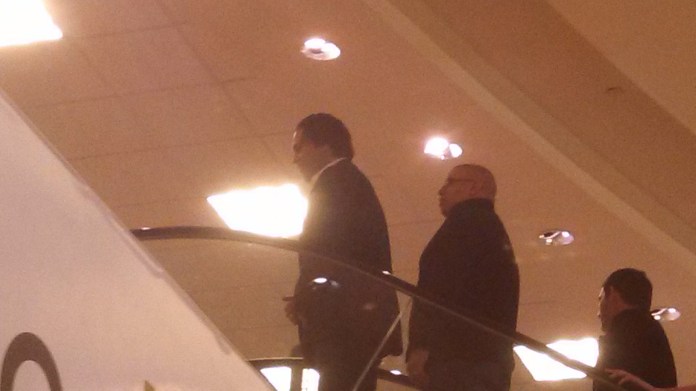
A small crowd was gathered, not part of the signing line but around a side door.  I joined the crowd.  And all of a sudden, like it was nothing, the door opened, and Mike Piazza walked through it.

Most of the store didn’t notice.  They were already in line, craning their necks to look ahead to where they thought Piazza must already be sitting.  But he wasn’t.  He moved through the crowd that had gathered, shaking hands.  He shook my hand, and I stuttered something inarticulate.  Then, as the gathered masses began to notice him, he made his way up the escalator – the line, it transpired, was two whole stories long – and got down to book-signing.

That’s right: I shook hands with Mike Piazza.  I shook hands with, starting yesterday, a Hall of Famer.  As soon as he’d moved past me, I whipped out my phone and got a picture as quickly as I could.  You can barely tell who it is: little more than a figure getting off an escalator.  But I know who it is.

It’s Hall of Famer Mike Piazza.

image1

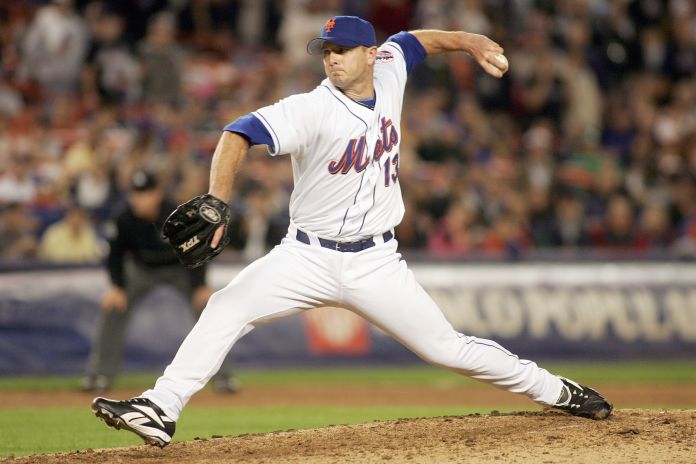
And after years of anger, speculation, frantic vote-counting and voracious disagreement with a Pedro Gomez-led stubbornly stupid BBWAA voting bloc, the designation is official.  Mike Piazza, greatest offensive catcher of all time (and, it turns out, an undervalued player on defense), is a Major League Baseball Hall of Famer.

Nitpicking remains, namely the logo on the hat on Piazza’s Cooperstown plaque, but as far as I’m concerned, it’s not important.  Piazza was our franchise player, our guy, the face of New York.  Piazza provided great moments in Mets history, and, on September 21st, 2001, in United States history.  In two different versions of Terry Cashman’s “Talking (Mets) Baseball,” Piazza has lines dedicated to him.  If that, along with the consecutive playoff appearances, the iconic moments, and the six minute long ovation as his Mets tenure ended, doesn’t make him a Met, I don’t know much else that could.

So that’s that.  After all these years, we’ve got a counterpart to Tom Seaver to visit in Cooperstown.  We’ve got, potentially, a second player to join The Franchise on the left field wall.  We’ve got another name in the conversation when Hall of Famers come up, and the Mets are brushed aside, almost spitefully, with, “well yeah, but who do you have besides Seaver?”  And most importantly, the transcendent greatness, superstardom, and offensive badassery of our guy, our friendly neighborhood catcher, has been recognized, and broadcast for the world to see.

And you may say that the Hall doesn’t matter.  But so long as Mike’s happy about it, I’m glad he finally got in.

Standard

Here’s To The Forgotten

GettyImages-71219842.0We can argue all we want over whether Mike Piazza belongs in the Hall of Fame, but when we frame the abysmal record of the BBWAA’s voters in a purely Steroid-oriented context, we do a disservice to those other players who have been unfairly passed over.

Well, actually, we can’t argue much about whether Mike belongs, because it’s clear beyond a shadow of a doubt that he does.  It’s not an argument anyone with any common sense is interested in having.  And, by the way, the same applies to Gil Hodges, although he won’t be the subject of contention for another two years or so.

But in reality, the mental limitations of Hall of Fame voters go far beyond steroid rumors.  There are whole hosts of players out there who, to many, and by many measures, are Hall of Famers, but who have been completely forgotten – in some cases, pushed off the ballot entirely.

Now, this isn’t about the close calls.  This isn’t about Alan Trammel or Tim Raines or Lee Smith, or any of those guys who are getting 50 to 60 percent of the vote and might very well get in one day.  This is for the other guys.  The five to ten percenters.  The forgotten.

First, related to Lee Smith: the Hall has a reliever problem.  I understand that sabermetrically speaking, relievers don’t have the value that starting pitchers do.  But first basemen don’t have the value that catchers do either, yet we’ve elected many, many elite first basemen to the hall.  Relief pitching may be less valuable; that doesn’t mean that those who engage in it are less deserving of the honor of Hall of Fame induction.

And that brings me to the first of the forgotten: Billy Wagner.

Now, this might just sound like Mets bias, but it’s not: Billy Wagner is, by all sensible measures, an all-time great closer.  He’s certainly better than Trevor Hoffman – Wagner beats Hoffman in E.R.A. and E.R.A.+, and their WARs are nearly identical.  Nearly identical, that is, despite Hoffman pitching two years longer than Wagner did.  Billy Wagner’s career E.R.A. is 2.31, and he pitched through the heart of the Steroid era.

Here’s another thing about Wagner, that is vastly and systematically under-appreciated: he went out on top.  Billy Wagner retired when he wanted to, when he decided he had had enough.  In his final season, his E.R.A. was 1.43, and he saved 37 games.  Trevor Hoffman’s E.R.A. in his final season was 5.89.  Going out on top isn’t so common.  Ted Williams did it.  Mariano Rivera did it.  A player retiring when they want to, and leaving the league more powerful than when they entered it?  That’s a Hall of Fame move in my book.  Wagner will likely get five to ten percent of the vote this year, and, more likely than not, will drop off the ballot at some point because of lack of support.  But to me, he’s a Hall of Famer.

Now, on to other matters.

Alan Trammell has gotten some significant support, at least from the non-voting segment of the population.  But there’s another shortstop who’s been almost entirely forgotten: Nomar Garciaparra.

Trammell played longer than Garciaparra did, and therefore, has more hits and a higher WAR, but if I had to choose one of the two to elect, it’s Nomar every time.  Trammell was a career .285/.352/.415 hitter.  Nomar had .313/.361/.521.  That’s an .882 OPS from a shortstop, and that’s not something you see every day.  Nomar got 5.5% of the vote last year, and will probably drop off the ballot this year.  And while he may not have the quantity for a Hall of Fame career, he’s certainly got the quality – every bit and then some.

.300/.400/.500 was supposed to be Hall of Fame material – I don’t know when the writers disavowed that particular unwritten rule, but it’s a shame that they did, because Larry Walker and Edgar Martinez both belong in the Hall of Fame.  Walker slashed .313/.400/.565 for his career, while Martinez had .312/.418/.515.  OPS’s of .965 – .965! – and .933, respectively, and neither stands much chance of induction.

Both Walker and Martinez, despite stellar career numbers, have been victimized by forces beyond their command.  For Martinez, it’s anti-DH bias, which doesn’t make much sense.  I’m anti-DH as much as the next National League Baseball fan, but if you’re not going to elect a quality DH to the Hall, don’t play with ‘em.  For Walker, it’s Coors Field bias: he played his prime years as a Rockie, and despite a career OPS+ of 141, just one point below Mike Piazza’s, voters can’t seem to recognize him as a legitimate superstar of his era.  They also both suffer from steroid era bias, of course – among the current BBWAA electorate, it’s hard not to.  But despite the biases, Walker and Martinez both belong in the Hall.  Martinez’ support, at least among public ballots, has gone up this year, but Walker’s has not, and it’s more likely than not that neither will be elected.  And as two hitters with .300/.400/.500 slash lines, that’s a damn shame.

And finally, you’ve got the two forgotten sluggers, Delgado and McGriff.

The obsession with 500 home runs is a little strange, to me – it doesn’t really make sense that, had Fred McGriff returned to play one more full season, and batted .146 with eight home runs, he would have become an automatic Hall of Famer.  Nor does it make sense with Delgado – Carlos, who ended his career with 473 home runs, hit 38 in his penultimate season, then got injured.  He worked to come back, but ultimately, his career was over.  One more healthy season could quite easily have put him over 500 career, but…well…he’s got 473.  Your move, voters.

While Delgado’s most impressive stat could be his career .929 OPS, McGriff’s is his consistency.  From 1987 to 2002 – 16 consecutive seasons – he hit at least 18 home runs each year, and batted .287/.380/.514.  Those 16 years included ten with at least 30 home runs, and eight seasons with an OPS above .900.  He finished his career with 493 home runs, and was never linked to steroids.

Both Delgado and McGriff, beyond the obvious steroid era bias, have likely not been elected due to position and consistency bias.  Both were first basemen, which necessitates a higher offensive output among voters, and both spaced their production more or less evenly throughout their careers – neither had that mythical seven year peak that voters like.  But more than anything, it’s simple numbers thinking.  500 home runs is automatic induction, without steroids.  But McGriff has less than 20% public support this year, and Delgado dropped off the ballot last year after only 3.8% of the vote.  Apparently, almost 500 does not mean anything.

So there you have it: the forgotten.  Six players.  Five will likely receive less than 20% voting support on the 2016 ballot.  One – Martinez – may get more.  But he almost certainly will not get in.

I see six Hall of Famers – or, at least, players who deserve more than 20% support, or dropping off the ballot after one year’s token appearance.  But apparently, the BBWAA does not.  And until something changes, they – and not, in their minds, the players they write about – are the only ones that matter.

Standard

The Winter Of Our Discontent

It’s a New Year, the Jets (and Giants, but really, why bother) are done, and – allegedly – 44 days remain until Pitchers and Catchers.

In other words, it’s Baseball Season!

44 days remain until pitchers and catchers begin congregating in Port St. Lucie.  Maybe 30, or fewer, before the more diligent guys show up for infield drills.

Until then?  Nothing.  Blackness.  A protracted exercise in patience and lack thereof.  A seemingly endless slog of one day after another, each having only one thing in common: a colorless, almost painful lack of baseball.

Not that there’s nothing going on in the interim.  It’s a somewhat comforting thought to know that between the exploits of Kristaps Porzingis, the seemingly disappearing tenacity of the Rangers (the Hockey Rangers, that is), and the weekly presentation of NFL playoffs which always seem to produce their fair share of heroes and villains, we’ve got our fair share of sports to keep us going until those first images of Spring in Port St. Lucie start filtering in.

And really, what is Spring Training itself?  I love it as much as the next guy – there’s nothing wrong and everything right with finding a way to trick yourself into thinking it’s early summer in the middle of February.  But nothing much happens during Spring Training, usually.  Especially not during the early parts, where the most newsworthy items are, too often, which pitchers have chosen to grow or overtly alter their hair.  The beginning of Spring Training isn’t official: this year, it will be marked, more likely than not, by a few blurry photos of David Wright arriving in Port St. Lucie.

This, the present, is the worst time of the year; there’s no denying it.  The cold, the general gray atmosphere, and that abominable wind all combine to create just about the least baseball-friendly atmosphere anyone could imagine.  Well, besides those numskulls who decided that early spring baseball in Denver and Minnesota was a good idea.

Yes, we’re making our way through the worst time of the year right now, but that’s actually not such a bad thing, because despite its being the worst time of the year, we are, in fact, making our way through it.  Spring Training – and, as far as I’m concerned, Baseball Season – begins in 44 days.  We spent 63 days, from August 2nd through the end of the regular season, in first place, and that passed more quickly than the time Hansel Robles takes between pitches.  In 29 days, it will be February, also known as “The very same month during which Pitchers and Catchers report.”  For 29 days, from October 4th to November 1st, we were the Postseason Mets.  The 29 days of 2015 postseason was the best time I’ve ever had.  The next 29 may be just about the worst.  But just like the postseason did, this period will end.

And imagine this – the offseason, barring a truly Mets-opotamian fiasco, will end with less heartbreak than the World Series.

It’s a strange comparison to make – probably because it’s based on some kind of logical fallacy that I could find if I examined the argument more closely – but the point remains: there’s no risk during the offseason.  There are few highs and few lows, and those few that do occur are rarely all too far in either direction.  Finding out that Alejandro De Aza was as good a center fielder as we were going to get was a low point, but it wasn’t heartbreaking.  Replacing Murph with Neil Walker wasn’t heartbreaking either, although I hope I didn’t just jinx Walker’s ability to keep our hearts, fragile from the loss of the World Series and our second baseman, intact.

So Spring Training will come, and although the things we see and hear out of Port St. Lucie won’t anything, Spring Training itself will mean very much indeed.  It will mean an impending Spring, right around that proverbial corner.  It will mean that baseball, first the Spring Training version and then the Regular Season, is just about to begin, or, at least, that it’s one step closer to beginning.

“Dad says the anticipation of having something is often more fun than actually having it,” said Calvin of Calvin and Hobbes in an early 1990s strip.  “I think he’s crazy.  I hate waiting for things.  I like to have everything immediately.”

Asked for a counterargument, or anything that one would truly rather anticipate than have immediately, Hobbes can only respond with “Death comes to mind.”

But in this context, maybe Spring Training, and that glorious time that is regular season baseball, is in the same category.  We can’t have it all year ‘round, for a multitude of reasons, and the offseason has seemingly found that magic length – the exact amount of time needed to build up anticipation, slip in a little desperation, and just when all seems lost, mercifully end.  We’re approaching the halfway point, after which things will slip painfully slowly towards sun, warmth, and baseball, and once we reach that point, sometime in the next few weeks, we won’t look back.  But even now, we’re far closer than it would seem.  Spring Training will begin in 44 days, and we’ll look back on today like it was yesterday.

So let’s not drown in the boredom of the offseason, but rather, look ahead.  Watch the highlights, read the columns, debate the merits, and consider the possibilities, but don’t do it with a mournful eye, yearning for a season that just ended and will not be back, but rather with an air of optimism.  We’ve got a helluva team, and even if we don’t, we’ll be sure that we do, because we’re Mets fans, and we gotta believe.  The interminable offseason will end just like the World Series ended.  We were saddened – brokenhearted, even – when Wilmer struck out to end game five, but we were also proud.  So let’s get through this pesky offseason, and as the Mets continue to play ball in a fashion that may not always be so absolutely bad-ass as the 2015 season was, let’s remember the pride.  Let’s remember that we’re fans of people, not machines, and the reason that we’re Mets fans is that we care about not only the team on the field, but the guys who make up the team.  Wilmer Flores may disappoint in 2016, but please, don’t forget that the thought of leaving this team once drove him to tears.  Daniel Murphy will work against us as a National, but please, remember how hard he worked for us, practicing tirelessly until he became an almost average defensive second baseman.  You know the drill.  Wright may underwhelm.  Harvey, deGrom, and Thor may not be the trio of awesomeness that they formed last year.  But that’s the reward that awaits, when the offseason finally departs: our team will finally be back on the field, doing what they love, and we’ll be watching from the stands.  And to me, that’s worth the anticipation of a few months and then some.

And while you’re at it, if you’re wondering just how long the wait really is until Pitchers and Catchers report, there’s no quicker way to check than the Shea Bridge Report official Spring Training Countdown, now available.

Standard

Ain’t That A Dropkick In The Head

Oh no, the Mets didn’t get Ben Zobrist!

Oh no, the Mets didn’t commit to giving a 35 year old player 13 million dollars a year until he was 39!

In other words, good move, Mets!

With today’s news that Ben “The Inexplicable WAR Anomaly” Zobrist has agreed to a deal with the Cubs (last night, apparently, although the Mets somehow awoke today ‘very optimistic’ that they would get him, and please don’t ask me how because I just don’t know), speculation turned immediately to Daniel Murphy. What will he get? Who knows? Where will he go? Not Queens, if the Mets front office has anything to say about it, and the scary thing is that they almost certainly do.

Zobrist is older than Murph, but better on defense. Zobrist hit 13 home runs last year to Murph’s 14, and stole three bases to Murph’s two, so there’s not much there, but Murphy is also coming off a playoff stretch that I’m sure we all remember. Murph is just entering his prime; Zobrist is leaving his. Murph can steal bases just like Zobrist used to: two years ago, he stole 23. Forced to guess, I’d say Murph gets a deal similar to what Zobrist got, or maybe slightly less.

I really don’t know why the Mets don’t want to pay him. I simply cannot figure it out. Realistically speaking, it can’t be a defensive concern: Murph has steadily improved his defense every year. This year, despite the error that everyone will remember, he was about average. And it can’t be an offensive thing either, because by all measures available, Murph is one of the top offensive second baseman available. Murphy’s career OPS is 755. Asdrubal Cabrera, touted as a possible replacement, has .740. Wilmer Flores has .687. Ruben Tejada has .653. Murph is the guy – if you want offense, and boy oh boy the Mets want offense, you needn’t look further than Daniel Murphy.

But the reasons we need him – because we do need him, we absolutely do – go beyond that. Daniel Murphy, while maintaining his quiet, steady offensive presence, has become an all-time Met. He’s 2nd all-time in doubles. Eighth in batting average. Among all-time Mets second basemen, Murph’s OPS is second only to Jeff Kent. And it goes even further: Murph is – or perhaps was – the last Met to play at Shea Stadium, besides the captain. Murph is the last Met, again besides the captain, who remembers what it was like to play for a team – the Mets of 2006-2008 – that flirted with greatness not as a sudden phantasm, but as a recurring expectation. Murph can handle New York. Murph can hit in the postseason. Murph hits well at Citi Field. The list of intangibles, somewhat-tangibles, and overtly-tangibles goes on and on, and if anything exists that says that he’s not worth $10 million, or even $13 million a year, I can’t find it.

Unfortunately, it seems all but certain that Murph is headed out the door. The Mets have done all but shout publicly that they’re not going to bring him back – well, actually, they’ve done that too. They’ve said publicly that, after losing out on Zobrist, “There is no backup plan.” I hope everyone’s ready for Tejada at short and Dilson Herrera splitting time with Wilmer at second, because that’s what it’s looking like. Murph, you were a helluva player and a helluva teammate off the field (next year, when they ask him how he hit 30 home runs and batted .320, he’ll say that he couldn’t have done it without the team around him, and then list each guy individually). And watching as your time as a Met ends, it’s even worse knowing that by all logical and reasonable thought, it shouldn’t be.

Standard

‘Dem Amazin’ Bums

It’s tough to know exactly how to feel about this, because I’m a Mets fan through and through, but we all get nostalgic sometimes (pretty much constantly, in my case), and today – honestly, for all intents and purposes, daily – I got to thinking about the Dodgers.

Yes, I know the Dodgers have not played a home game in New York since 1957. No, that does not change the fact that somehow, I feel like the Brooklyn Dodgers are my team.

Perhaps this is because the Mets have done such a job at replacing them. The two outer-boroughs teams, both overshadowed by the evil empire of the Bronx, two teams of the working public, teams that belonged to the people, in all but the most literal sense.

The Dodgers constantly battled the Yankees for that elusive World Series title before finally winning one in 1955. The Mets don’t really have a comparable story, for one because divisional play means you don’t see the same two teams in the World Series every year, and for another because we don’t really have one rival, but will assign the role to whichever NL East team is better than we are. But still, the Mets give off that same sense that the Dodgers seemed to: always working their hardest, not often succeeding but always giving everything they had.

Terrible owners; long stretches without championships; players who fans connected with on almost friendly levels (it seems like every 70 year old guy from Brooklyn has a story about the time he met Clem Labine at the deli)…the Mets are today’s version of Dem Bums, and as much as the negative aspects can wear down on us die-hards, I hardly think I would find it preferable to be a fan of New York (AL), who seem to treat fun and championships as a zero-sum game. Sure, they win – but will they ever have Thor? Will they ever have Justin Turner in his heyday? Will they ever have any of the old Dodgers who made Brooklyn their home and played each game with just as much enthusiasm as the teenagers peeking through the Ebbets Field fence, trying to avoid the patrolmen who discouraged this behavior, if halfheartedly?

No, they won’t, because they’re a business. They’re not in it for the fun; they’re in it to win, and move on. Why don’t any of the Yankees even have nicknames these days? The Mets do – Thor and Batman and Superman and Murph and the Captain and Yo (gone, thankfully) and even Familia, whose last name sounds so much like a nickname already that I suppose it could count if you were being generous. Dodgers fans knew their players as friends; Pee Wee and Jackie and Gil and the Duke of Flatbush, “The Reading Rifle” Carl Furillo, Junior Jim Gilliam and, of course, Campy himself. Just consider it: Travis d’Arnaud, listening to the fans as he warms up, is subjected to shouts of “Hey, Trav!” Wilmer Flores hears, “WILMER!!!” You’re not going to tell me that Brian McCann hears “Hey, Bri!”, or that Stephen Drew hears “STEVE!!!” No, they hear “McCann” and “Drew,” because Yankee Stadium is, let’s face it, less like a ballpark and more like the executive office of a win production factory. Do they produce wins? Usually, sure. But is it really somewhere I want to go for thrills and fun?

So, the Dodgers. They left 58 years ago, and if they ever come back, it won’t be for about another 58, at least. Frankly, I’m not sure the Dodgers of old would fit in in the Brooklyn that they would come back to. Brooklyn in 1955 was populated by people who worked for what they needed: Brooklyn in 2015 is populated – and if this is a stereotype, it’s a very widespread one – by people who wear man-buns and eat artisanal kale by the truckload while watching socially conscious Buzzfeed videos. The deli owner down the street with the thick accent who had a framed picture of the time Dolph Camilli bought a sandwich from him…those people are gone, and it’s a shame for Brooklyn that they are.

If I had to reach a point, this would be it: the Mets are today’s Brooklyn Dodgers, and there is absolutely nothing wrong with that. “Wait ’till next year” was the sometimes ironic motto of Dodgers fans, and if we don’t live up to that, I don’t know who does. I’d love to see a title a year, and a group of superstars who didn’t care one bit about the game but did what they needed to do to win. But you know what I’d like even better? The team we have now – Wright and deGrom and Thor and Murph (man, I hope) and Matz and Harvey, who looked at his innings limit and said, a la Stewie Griffin, “Hey – shut up,” and Familia and Lagares and d’Arnaud and every damn one of them. That’s my team, and I get the feeling it’s also a team that Brooklyn Dodgers fans would be proud to support. And from my ball club – not from my accountant, my lawyer, or my physician, but from my ball club – a group like that, who plays hard and has fun while doing it, is all I need.

Standard

2015: A Year To Remember

I had a different post planned tonight.

I promise you, I did. It was really nice. It was all about listening to the radio after I was supposed to be asleep as a nine year old, and the necessity of letting go and accepting the past, and moving along as times – and teams – change.

I’m writing this one instead.

This series – this whole goddamned series – was just too much – however you look at it – not to be sent off, by me, with a personal touch. I had several messages to deliver over the course of the series, and if not now then never, so I figure, why not.

To Terry Collins: I wish I hadn’t predicted that your bullpen management would cost us the postseason way back in August, but there’s a silver lining: my friend who disagreed with me was wrong, and I was right. Logan said to me, and here I quote directly, “Terry’s management style is just letting Harvey pitch a complete game.” Unfortunately prophetic.

To Kevin Long: I get that our offense improved this year, but do you have any drills to cure streakiness?

To Yoenis Cespedes: You were fun for a few weeks, but no longer. I shouted that you were a bum about twenty times during this series – roughly the same amount of times you struck out on fastballs up and in – and as a major league baseball player angling for a six figure contract, you’d think that you’d work to fix that, but hey, you do you. I hope you’re priced out of the Mets range, because no offense, but I’d like never to see you in Queens again, even as an opponent, because if you do come back as an opponent, I’ve watched the Mets enough to know how that turns out: you hit a three run homer in the top of the ninth, then rob a home run for your team in the bottom to end the game. So thanks, Yo, but you really ended up a bum.

To Michael Conforto, Matt Harvey, Steven Matz, Jacob deGrom, Juan Lagares, Jon Niese, Bartolo Colon, and Noah Syndergaard: you could not have done more. I’m so proud to have you guys on the team going forward, besides Colón, unfortunately, and I’m looking forward to greatness in the future. I’ve got a good feeling about this group: let’s make it work.

To Lucas Duda: I shouldn’t be the one pushing Kevin Long for the streakiness cure. That should be you. I understand that some hitters are streaky, but when you hit 20 home runs in eighteen days and seven the rest of the year, or whatever it was, you need help. Plus, you weren’t much help in the postseason, not to point fingers.

To Daniel Murphy: Murph, I want you back. It doesn’t seem like that’s going to happen, but who knows: maybe those last few errors brought you back to our price range. If you leave, however, I’ll remember your Mets tenure fondly, and I sincerely apologize for the boos you’ll get when you come back to Citi Field. This is absolutely sincere, by the way: Daniel Murphy is one of my favorite Mets, and I think they’re crazy not to bring him back.

To Addison Reed: for some reason, watching your motion fills me with confidence, even if it’s not always founded on anything concrete. Maybe you’ll be back. I hope so, because we need bullpen help like Chris Christie needs SlimFast.

To Tyler Clippard: It’s unfortunate that you will go down in history as one of the most forgettable Mets of all time. Go pitch for the Astros or wherever, and if you’re ever pitching against us, don’t forget that you owe us more than a few games.

To Kelly Johnson and Juan Uribe: honestly, you guys made this season for me, more than anything else. Bringing in two guys who were professional hitters – honestly, you’d do Danny Heep proud – made me believe, for the first time, that maybe we were on to something. One or both of you may be back, but thanks for the memories.

To Jeurys Familia: the Mets sincerely apologize for crediting you with two blown saves despite recording four infield ground balls. Keep it up, because good gracious we need you in the pen.

To Curtis Granderson: You’re the real MVP, or at least the real reassuringly solid player. Keep it up, please, because with someone like that at the top of the lineup, anything can happen.

To the MLB on FOX broadcast crew: Please never speak again. Staple your mouths shut if possible. I haven’t heard such idiotic blabbering nonsense since the last Republican Debate. Sincerely, literally the entire world, including Joe Buck’s wife.

To the media at large: let’s call this one like it was. The Royals played well. They were not greek gods of making contact; they did not hammer us with a barrage of line drives from which we shied away in terror; they did not run us down in a tornado of relentlessness. I’m sorry, but the Royals got lucky, and that’s all there is to it. Call it whatever you want: when you score the tying run on a soft ground ball two days in a row, being relentless doesn’t have anything to do with it.

To the people who were in my room until I kicked them out: I probably overreacted, but all the same, I still think it might have been your fault.

To the Yankees and their fans: I envy you, because you’ve been relaxing at home all this time, and I’ve been stressing out over my team playing in the World Series. Sucks to suck, and sucks to continue to suck because your team is not going to stop aging, if you know what I mean.

To Sandy Alderson: thanks, and all. Can we not have another six-season gap before our next winning season?

To the Wilpons: don’t think one good year means you can slack off.

Finally, to David Wright, Howie Rose, and Gary Cohen: you’re all in the same boat here – waiting longer than anyone else for a championship. We’ll get one some day – next year, if the Royals’ success is any indication – and I’ll be proud to call you my captain and broadcasters when that does happen.

For the final time, from Citi Field, your 2015 New York Mets.

Standard

One Last Journey To Be Made

You could call yesterday’s win, among other things, a meeting of a great multitude of journeys.

Terry Collins, I suppose, should come first.  He’s been from Pittsburgh to Houston, Anaheim to Tampa Bay, on to Japan for two seasons, and then on to Queens.  We’ve griped occasionally – well, more than occasionally – when the goings have been tough, but thanks to Terry and his inexplicably aggressive and overwhelmingly successful postseason managing, we’re at the point that we are tonight.

Lucas Duda drove in five runs tonight – his journey, in the short run, has been from slump to slug faster than anyone can possibly keep track.  He hit his stride in game three, kept – I don’t know, striding? – in game four, and finished the day with five RBIs.  Terry has suggested that if Duda gets going, “we can be golden.”  That’s very true; or, in Terry’s parlance, that’s gravy.  Duda was bad all postseason, but he came through in game seven.  That’s what we’ll see on Mets Classics in twenty years.  That’s what matters.

And then there’s Murph, because at this point, pretty much anything you mention can be realistically described in terms of Daniel Murphy.  If you said “eggs,” for example, I’d tell you that eggs were best described as a potential breakfast option for Daniel Murphy.  If you said “America,” I’d say that Daniel Murphy lives there, ‘nuff said.  With his 8th inning home run, Murph broke the record for consecutive postseason games with a home run.  Whose record did he break, with the home run that lodged the final nail in the Cubs coffin and helped win an NLCS and send the Mets to the World Series?  Carlos Beltran.  The symbolism there is borderline alarming.

Jeurys Familia closed it out – that’s a sentence that we’ve gotten used to over this season, and it’s proven true in our two series victories so far.  Familia started out in Venezuela.  The Mets signed him in 2007.  He came up in 2012, was okay in 2013, was dominant in 2014, and started out 2015 as the setup man, which didn’t make sense, since it was clear to just about everyone that Jenrry Mejia, PEDs or not, was nowhere near as monstrous as Familia was.  Sure enough, Mejia went down, and Familia was the closer.  No one’s looked back since.  You can look at the numbers – 43, 1.85, 2.7 WAR, 9.9 K/9…etc.  You don’t need the numbers to see that whatever Familia’s throwing – his pitches, at this point, defy conventional naming standards – is nasty.  He’s now got a nice stretch of off days before the series starts.  Good luck with that, opponents.

And so, these guys, and others, came together, played together when they were healthy, picked each other up when they were injured, and got the big hits when others didn’t.  It all led to tonight, when a win could put us in rarely-charted territory, and started right from the gun.  Granderson singled.  Wright – boy oh boy, does he deserve this win – struck out.  Murph – let’s be honest, we all expected a home run here – popped out.  With Cespedes up, Granderson stole second.  Cespedes, on the pitch that he’s been swinging at and missing all season, left the bat on his shoulder and walked.

If that didn’t augur success, you haven’t been watching this team.

Then it was Duda, who we all hoped was off the schneid.  He took some pitches, he missed a nasty breaking ball, he fouled some pitches off…I, to be honest, wasn’t optimistic.

These are the 2015 Mets; who needs optimism?  We’ve got the team work to make the dream work, in more ways than one.  Duda homered, and d’Arnaud, before we could get done fist-pumping, followed suit.

Teamwork.

For a game that, after the second inning, was never closer than five runs, it sure seemed like a nail biter.  The Cubs had their chances: the captain helped us dodge a bullet in the fourth when he nabbed a Starlin Castro liner with a leap worthy of a 23 year old, and Bartolo – yet another guy whose presence on this team is nothing short of surreal – helped us avoid another when he struck out Kris Bryant with two on in the fifth.  Of Kris Bryant’s 23.5 years of life, Bartolo Colón has been a professional baseball player for about 22.5.  It couldn’t get more cinematic Tarantino had written it.  The wily vet – the 300 pound vet, to make things that much more interesting – strikes out the young slugger, and commands the opposing lineup?  Like I said: surreal.

The Mets stranded men at third in the sixth and the seventh, and if I know my people, there wasn’t a Mets fan in the world who wasn’t convinced, at that point, that we would lose 7-6, victims of our failure to bring home that all-important runner-at-third-with-less-than-two-outs (did you ever notice how the broadcasters always say it the same way, as if it was one really long word?).  We Mets fans can be stubborn: maybe this win will help pound the final nail in the coffin of ’07/’08, but remnants of those years will surely stick with us forever.  I don’t know that I’ve ever met a Mets fan who wasn’t concerned, deep down, that a 6-1 lead in the eighth wasn’t enough.

But this team is different, as they’ve insisted to us all season.  This isn’t the ’07 debacle, or the ’08 wilt.  This is one helluva group of players – one that, I daresay, reminds me more and more of one of those underdog championship teams from inspirational sports movies.  This team is not the type – well, outside of that one game against the Padres with the two outs, the delay, the home run, the second delay, and the eventual loss – to give up leads late.  We’ve got Familia.  Literally and figuratively.

Clippard entered for the eighth and immediately resembled D.J. Carrasco.  That was Clip’s m.o. in the second half of the second half of the season, but it had seemed that perhaps he’d regained his third-quarter form.  Maybe not.  But he settled down, got his outs after giving up two, and handed it over.

Oh, and Murph homered somewhere in there too, but you already know that: as Ernie Johnson said yesterday, Daniel Murphy hit a home run because a game was played.  It’s that simple, at this point.

Familia entered.  Coghlan grounded to Murph.  La Stella grounded to Murph (boy, the Cubs just cannot shake the whole “Murphy” thing, can they?).  Montero walked.  Being a Mets fan, this was enough to raise my heart rate about 30 percent.

I needn’t have worried: as I’ve said, this team is about as different from the 2007 mess as can be.  Familia worked on Fowler, wore him down, and ultimately brushed the upper limits of the strike zone with a fastball that was too close to take, although apparently Fowler hadn’t been made aware of this.  Strike three.  Put in the books.

These Mets haven’t been together for long, and I’m not deluding myself into thinking that they’ll all be together next year – although Daniel Murphy, and I mean this with all of my heart, had better – but they’ve already accomplished what many thought impossible: what the Dodgers, with their $300 million payroll, and the Cardinals, with their vaunted – well, just about everything – could not.  Mets fans, let it sink in: we’re going to the god damn World Series.

You could, I said, call the win a confluence of journeys.  That’s nice in itself, but it’s not all.  Thanks to Murph and Granderson and Wright and Familia and Matz and Colón and every single player on this wonderful team, we’ve got one more journey to make.  And from what I’ve seen, we’ve got the stuff to come out victorious one last time.

Standard