Win, Win, Win

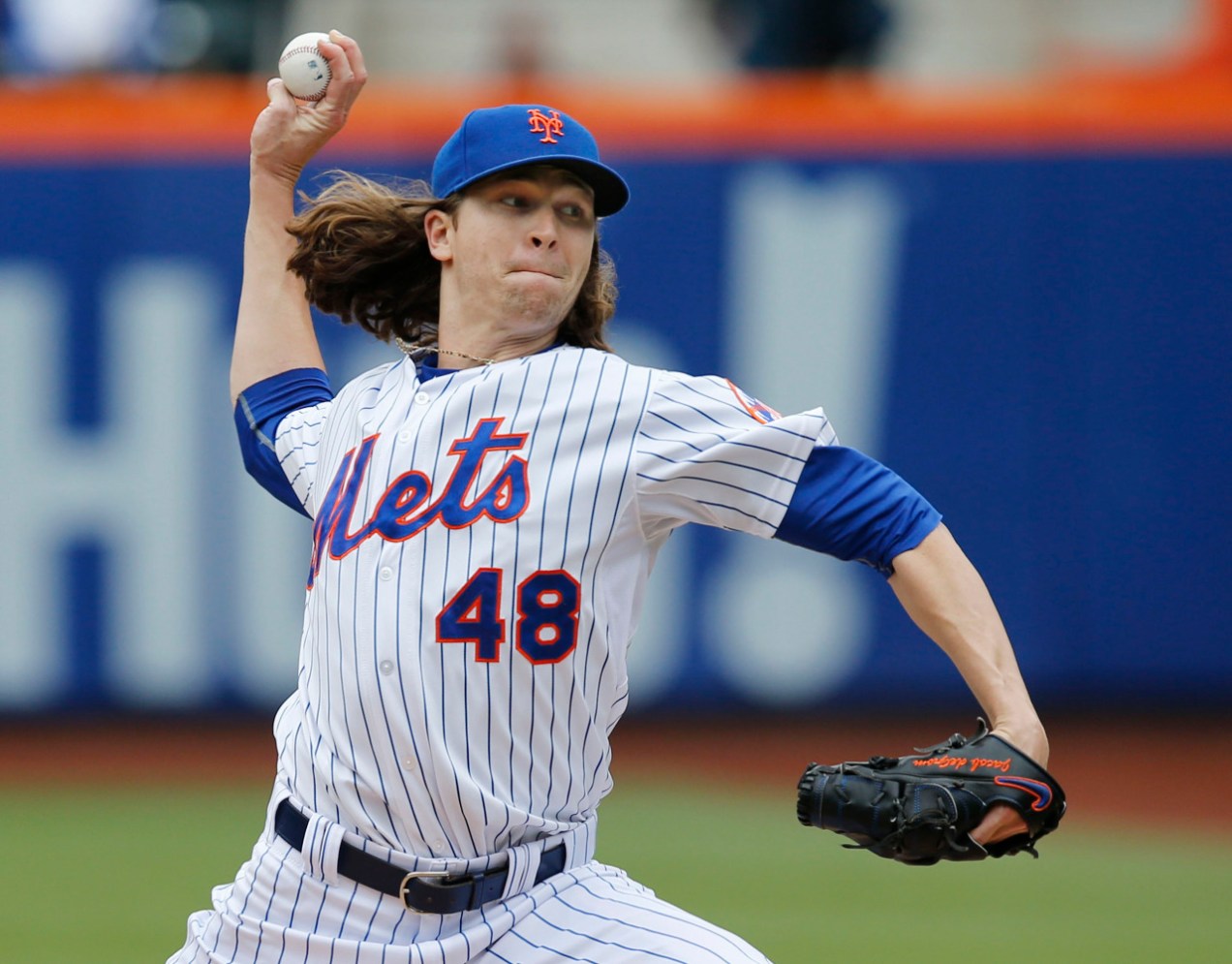
When Jacob deGrom left Thursday night’s game, and social media was immediately swamped with reports that he had retreated to the clubhouse and brought Ray Ramirez with him, the doomsday predictions immediately began.  But I looked at things slightly differently.

“We’ve been winning a game and losing a player every night,” I said to myself.  “I guess we’re going to win.”

But most of Mets fandom, judging from twitter, wasn’t quite so cavalier about the loss of the third of our alleged four aces.  I couldn’t tell for certain whether the concern sprang from deGrom’s having a problem that necessitated Ray Ramirez’s attention, or the fear that Ray Ramirez would somehow exacerbate the otherwise minor condition (hey, it ain’t exactly unprecedented), but either way, we had some trouble on our hand.

Mets fans always do this, don’t we?  The minute everything goes wrong, we convince ourselves that the end times are upon us; we swear up and down that everything always goes wrong for us; we shout to high heavens that no one else has luck as bad as we do.  Now tell me, why on earth would we do that?

Ok, so maybe — again — it ain’t exactly unfounded.  Which is what deGrom said after the game: it’s a mechanical issue, nothing wrong, no drama to report here, now move along.  Is that what Matt Harvey said?  Yes.  Is it also what Steven Matz said?  Probably.  Is it what we’ve always heard from Mets pitchers the day before they announce that they’ll be out 12-18 months?  Indeed it is.

So is there cause for alarm?  I don’t know.  Ray Ramirez is involved, so by no means can we rule out the possibility.  But maybe deGrom is being absolutely straight with us: maybe there’s no problem at all.

deGrom got 14/15 of the way through a very good start before it all came undone.  A grounder that barely evaded a barely mobile Wilmer Flores, a base stolen barely successfully, then two doubles.  That’s not even to mention the two single but not quite double plays in the third inning, or the pitches around the plate all day on which Jake wasn’t getting the calls. If the dice fall differently, we’re triumphant right now, congratulating deGrom on a well pitched, albeit short start, and celebrating a mere 1.0 game wildcard deficit.

And speaking of cause for alarm, Jay Bruce got two hits — is that allowed?  One of them was a homer; the other also drove in a run — is this stuff that you could call “offense” or “hitting” going to be something that Jay Bruce does regularly in the future?  Jose Reyes had two more hits, frozen ropes the both of them, and is batting .295 — are washed up old guys allowed to do that?  Asdrubal Cabrera hit another home run — isn’t it alarming that he’s having, out of nowhere, what looks like a career year?  Can’t we also be alarmed positively?

Returning to the formula of win a game, lose a player, it all — for now — seems to have worked out just as planned.  We didn’t — yet — lose a player.  We lost a game.  At least there’s something we didn’t lose.

There’s always at least one win when you — that is, I — go out to Citi Field for a game: I win for getting to watch my ballclub play.  Everything else is just a bonus — and maybe not losing Jacob deGrom after seeming to most definitely lose Jacob deGrom is a bonus not quite on par with winning, but certainly up there.

I can’t help be reminded of that classic episode of The Office, entitled “Conflict Resolution,” wherein Michael attempts to become a mediator and must learn the different styles of resolution.  He wants everyone to win, obviously: don’t we all?

He brings the parties together in the conference room, and starts the mediation process: what kind of settlement do they want to reach?

Michael: Okay, this is important. The first style is lose/lose.

Oscar: What's the next one?

Michael: Just hold on, please! Okay, if we do lose/lose, neither of you gets what you want. Do you understand? You...you would both lose.  Now I  need to ask you: do you want to pursue a lose/lose negotiation?

As I headed for the subway after the loss, I wasn’t sure yet: would it be a lose/lose?  Would we blow the game and lose deGrom’s arm?

But then Michael moves on to other, much more palatable resolution options.

Angela: Can we just skip to whatever number 5 is - win/win or whatever?

Michael: Win/Win is number four, and number five is win/win/win. The important difference here is with win/win/win, we all win. Me too. I win for having successfully mediated a conflict at work.

But the news came soon enough, and until further notice, it’s what I’m going with: deGrom had mechanical issues, nothing more, and will be fine and dandy on his next turn in five days.

It didn’t look like the best of days, Mets-wise, at the outset.  But then we pull back to the big picture.  Jay Bruce may have gotten going.  Cabrera is still slugging away.  Reyes is hitting like he’s 24.  Despite our injury-a-day program, we’re two games out with 28 to play, going up against a Cardinal team that frankly doesn’t appear all that threatening, compared to Cardinals teams of years past.  And what’s more, I had one more chance to get out to Citi Field, sit under the New York sky, and watch my guys play one last time.

Win, win, win.

And hey, Thor goes tomorrow.  There’s another win right there.

Standard

A Three Inning Change In Perception

What is this bug the Mets have come down with lately?  I’m not talking about the winning bug, although that’s been fun too: I’m talking about this tendency we seem to be developing, to play complex, interwoven games where events of the fifth inning come back to play their roles in the eighth, and what seems inconsequential at 8:30 makes all the difference in the world ninety minutes later.

Yesterday’s turning point initially proved a false alarm, but ultimately came on a Granderson home run.  Tonight’s was different — and about as Metsian as can be.

In the bottom of the fifth inning, with Jake Esch tiring in his major league debut, Don Mattingly went to his bullpen.  And with Granderson coming up, he went to a lefty.

“Mattingly using his only lefthander in the fifth inning,” said Howie Rose.  I was driving along a dark, lonely road somewhere in the middle of Long Island.  At the time, I thought nothing of it, save the fact that it was extremely frustrating that Don Mattingly’s only lefty was shutting us down so easily.

A few times, we should have scored: the two double plays grounded into by Bartolo (but what the hell can you do?), as well as Granderson’s bid for a 23rd home run on the year that Ichiro pulled back in his trademark sigh-inducing fashion.

But we didn’t.  Several times, I thought the Marlins would.  They didn’t either.

So we went to the eighth, which you had to think was our last chance to win in any kind of normal fashion, before embarking on a 22 inning odyssey that would inevitably end at 3:00 in the morning and make us wish we’d been born in San Diego and had never chosen to root for this team.  So, we had to score in the eighth.  It was that simple.

I don’t like A.J. Ramos — that’s pretty simple as well.  I don’t like his lack of command, which put Travis d’Arnaud out of commission for more than half of the 2015 season with a broken finger.  I don’t like the way he dove violently into Jose Reyes in an ostensible attempt to cover the plate, which almost, but not quite, put Jose on the bench as well.  I just don’t like him.

So up until now, I’d enjoyed watching us score off him this series.  And here he was again.

A single, a walk, a productive out, and an unproductive out later, Travis d’Arnaud came to the plate.  Kelly Johnson, I knew, somewhere in the back of my head, was on deck.

And right then, I knew it.

“d’Arnaud’s going to walk,” I said.  “And Johnson’s going to get the runs home, because Mattingly doesn’t have a lefty.”

You know the story.  d’Arnaud walked relatively easily.  Johnson came up.  In my head, I’d expected a walk to drive home the go-ahead run, for no other reason than A.J. Ramos’ evidently chronic lack of control.  And sure enough, he went ahead in the count 2-0.

Then he swung over a fastball.

“Beat him with a sinker,” said Howie Rose.

“That was probably ball three,” I thought to myself.

Then a slider for strike two.  A fastball up and away.  Full count.

Just then, I had the good fortune to come up to a red light, hemmed in on either side by construction of the Second Avenue Subway.  Surrounded by metal, the radio turned to static.

But then, as if a miracle, in what I’m sure was caused by nothing more than Howie’s voice temporarily breaking through the steel curtain, I heard Ramos deliver.  And fifteen seconds later, we had a 5-2 lead.  And a few minutes after that, Familia had sealed the win in record setting fashion.

102615-MLB-Mets-Kelly-Johnson-pi-ssm.vresize.1200.675.high.19

The Marlins defeated again, A.J. Ramos humiliated again, and once more, a story that didn’t go quite the way any of us expected it would.  But once again, the ending is what matters, and the ending was everything we wanted, and then some.

You don’t think much of those little, nondescript events, like a manager opting to use his only lefty in the fifth inning.  Isn’t it amazing how often games are won and lost on the strength of those same nondescript events?

Standard

A Brief Departure From Our Story

Most ballgames have turning points.  Moments, when you look back later, about which you can say, hey, that’s when I knew we were going to win.

It could be an RBI double down 0-2 in the count.  A deep fly ball that gets pulled back for the third out.  A double play with the bases loaded that ends a rally and keeps a lead intact.

For a few minutes, I thought we’d have a point just like that tonight.  But in the long run, it just went to show that you can’t predict baseball.

It came in the bottom of the fifth.  Alejandro de Aza stood at the plate with two outs.  And as I watched from just behind the third base dugout, he struck out.

The pitch was in the dirt though: J.T. Realmuto boxed it around.  I saw De Aza sprinting towards first.  I saw Realmuto taking his sweet time to make the throw.  And I knew that De Aza would beat the throw to first.  And seconds later, that’s exactly what he did.

And what’s more, I knew that Wilmer, up next, would hit Tom Kohler’s next pitch to the Porsche Club and beyond.  Because isn’t that always how baseball works?  You catch a break, and you turn it into a run?  An opposing pitcher makes a mistake, and you make him pay?

That’s how I figured it would go, especially with Wilmer’s propensity for meaningful moments.  And when Wilmer drove the first pitch he saw deep to left, I was sure I was right.

So when the ball hit the top of the wall and De Aza stopped at third, I was thoroughly nonplussed.  But I kept myself together.  Making Kohler pay would have to wait one more batter, but we would get it done.  After James Loney was intentionally walked, that is — and isn’t that kind of astonishing in and of itself? — we would put some runs on the board.

It was Rene Rivera.  And he sent a perfect swinging bunt up the third base line.

Wasn’t the best way for it to happen?  A rally beginning on a dropped third strike, ending on an infield hit?  Beginning and ending with hustle?

And then Rivera was thrown out by a step at first.  And in my seat, I was thoroughly disheartened.

What a wasted opportunity, and wasted inning.  What a chance we missed for a memorable moment, one that we could point to when we made the playoffs as a turning point.  And what was more, we could have used the run.

Right then, I should have remembered that baseball never happens just the way you want it.  But what’s going to happen will happen, and whether it happens this inning or the next, there’s not much you, I, or anyone else can do to stop it.

And sure enough, leading off the sixth, Granderson delivered the blow that the Marlins had been waiting for ever since they’d botched a simple throw down to first.  And as his ball cleared the center field fence, I knew that we had the game in the bag.  And there was your turning point.

mlbf_527067183_th_45

Was it the story I’d wanted?  No, not exactly.  But sometimes stories take unexpected turns.  All that matters is that in the end, the story ended the way it should have.  And it wasn’t exactly poetic, but it was pretty darn close.

Certainly, you can’t predict baseball.  But if you try, you might realize, in the end, that you’re more right than you could have known.

Standard

3.5 Back, 35 To Play…

And so, we find ourselves once again in the heat of a playoff race, with 35 games to go, a 3.5 game difference between the Wild Card leaders and ourselves, and a whole lotta unfulfilled promise in the air.

When I stop and consider things, there’s more: along with everything else, there are signs of the first furious, back-and-forth playoff race that I’ve ever been a part of.

Last year wasn’t like that.  Last year, we went from three games back to three ahead faster than anyone could imagine, and then ran away with the division.  2007 was similar, but from the other side: we didn’t realize we were in a playoff race until it was too late.  2006 we were miles ahead of the pack.  2005 I barely remember, but from what I’ve heard, we never really had a chance.

So, going down the home stretch, we’ve got momentum, desire, and three teams to pass.  Can we do it?  I don’t know.  But either way, unless we drop out of sight and finish 12 games out, it won’t be quickly forgotten.

A 35 game stretch where every game could mean the season?  How often have we had something like that, recently?  We need to win; we need the Pirates, the Cardinals, and the Marlins to lose.  If that happens — and happens enough — we’ve got a wildcard game to win.  It’s that simple.

Again, can we do it?  I don’t know, but I think we just might be able to.  We’re better — far better — than a 64-63 team.  We’ve got pitching, even if most of it has been lost to injury like we all dreaded would happen.  We’ve got relief.  We’ve got some offense.  We’ve got Yoenis Cespedes.

All year long, we’ve been going wrong.  We lost Harvey; Matz turned bad; Cespedes hit the DL; Wright and Duda went down for the year; Familia had a bad patch; Wheeler had a setback.  All year long, our line drives have found the fielders’ gloves, in both a literal and figurative sense, and while this sets us up nicely for us to come out of the gate strong in 2017, maybe we’ve also got a shot to do something right now.

The early 2015 Mets, with no Syndergaard, no Conforto, no Cespedes, and even more damagingly, yes Michael Cuddyer, rolled off an 11 game winning streak.  It can be done; catching fire at the right time requires nothing more than blind luck and a little bit of talent.  We’ve got the talent.  All we need is some luck.

And maybe we won’t get it.  Maybe we’ll sputter and fade, and 3.5 games back with 35 to go is the closest the 2016 Mets will sniff to a playoff spot.  But that we’re here, ready to go, with 35 games remaining, should say two things.

First, we’re here, we’re not going away, and we’re down and ready to fight with everything we have for that last playoff spot.  And second, whether we succeed or not, it’ll be a fight to remember.

Standard

Prophecies of August 20th

Mets fans probably weren’t terribly excited on August 20th, 1968.  We were 23 games out of a playoff spot, little on the line as we took on Ray Sadecki and the Giants.  Sure, Tom Seaver was on the mound, but at this rate, it seemed we might never have enough hitting to get him the wins he deserved.

We struck first, though: Phil Linz, better known for angering an entire Yankees’ team bus with his harmonica, doubled home Jerry Grote and Ron Swoboda in the bottom of the second.  Swoboda drove home Cleon in the third, and Agee in the fifth, and then Linz struck again, singling home Cleon once more.  The icing came in the eighth: Cleon singled home Agee, then Swoboda cleared the bases with a three run homer.

Meanwhile, Seaver went six, and Cal Koonce went the final three.  When all was said and done, August 20th, 1968 ended in an 8-0 victory, Mets over Giants.

On August 20th, 1985, on the other hand, excitement was in the air.  The Giants were in town.  Doc was on the hill.  We know how this one goes.

Doc went the distance, as he always seemed, back then, to do.  Seven hits and three walks, both uncharacteristic, but also sixteen strikeouts.  The nine shutout innings lowered his E.R.A. to 1.74.

We went ahead, once again, in the second inning: Santana and Dykstra drove in Straw and HoJo, and Doc had two runs to work with.  He got another in the fifth: Carter singled home Backman.  One would have been enough.

1985 didn’t end quite as well as we would have liked.  But August 20th, 1985 ended in a 3-0 win, Mets over Giants.

But if 1985 was the beginning of our ascent to greatness, then 1987 was the first stop on our agonizing slide back down from it.  2.5 games back on August 20th, we took on the Giants, every game vital in the standings.

It was Terry Leach on the mound this time, but he didn’t last.  Davey pulled him in the third for David Cone, with the Giants already up 4-1.  Coney righted the ship: four innings, six strikeouts, not a run to speak of.  Keith had driven in Nails in the first, but in the fourth, we took Leach off the hook.

McReynolds started things off with a homer, a solo shot.  Four batters later, Santana drove in HoJo to bring us within one.  And in the sixth, with the bases loaded, Barry Lyons, just one in a string of memorable backup catchers that started around Junior Ortiz and hasn’t ended yet, took a Kelly Downs pitch over the wall.

Randy Myers pitched three innings to seal the deal, nine up and nine down.  And thus, August 20th, 1987 ended in a win, Mets 7-4 over the Giants.

August 20th, 2014 was a relatively unimportant game, if you categorize Mets games by importance, which I must say I don’t.  We were 13.5 games out.  Zack Wheeler was on the hill, facing off against Jeff Samardzija — now, I should note, of the Giants.

We weren’t playing the Giants that August 20th, but due to the advent of interleague play, we had the next best thing: the Oakland A’s, whose stadium, Howie noted on today’s broadcast, is just visible from AT&T park, on a good day with a good pair of eyes.

We had a more familiar cast of characters, that August 20th.  We had Wright, Murph, Grandy.  Duda, d’Arnaud, Wilmer, Lagares, Edgin, Familia.  It was hardly any different from the Mets of today.

This time, it was — who else? — Eric Campbell getting us started, homering to lead off the off the third.  With Duda at the plate later in the inning, Granderson came home on a wild pitch, and two pitches later, Duda drove a ball to the apple, bringing home three more.

Wheeler got hit around for two runs in the fourth and two more in the fifth, but meanwhile, Granderson was driving in Flores and Murph was driving in EYJ, and then Wilmer was driving home Duda to extend the cushion by one more run.  Vic Black allowed a run in the eighth, but Familia shut down the A’s in the ninth to shut the door.

We were 17 games out at the end of 2014.  But August 20th, 2014 ended in a win over the other Bay Area team, 8-5 over the A’s.

***

It wasn’t Tom Seaver but Bartolo Colón, and it wasn’t Phil Linz but Yoenis Cespedes getting us started, but the gist was the same.  This August 20th, we took on the Giants, and won relatively handily.

How will an updated version of this post read in 20 years?  “Cespedes, in his first game off the D.L., homered twice — nearly three times.  De Aza hit one as well.  Colón came out after 6.1, and got the win.  Wilmer and Ruggiano and Asdrubal Cabrera had RBIs as well.  Reed came in in the eighth, and ended the ninth with a line drive double play.  August 20th, 2016, thus, ended in a victory, Mets 9-5 over the Giants.”

And then they’ll describe how the year ended, but note that regardless, August 20th was a win.  And the implication will be there, clear as day if you can pick it out.

Maybe it’s nothing, but it certainly seems that when we beat the Giants — or, Bay Area teams, if you’re that nitpicky — on August 20th, beat them solidly and securely, we’ve got good years ahead of us.  From Phil Linz to Eric Campbell, Cal Koonce to Jeurys Familia, the Mets heritage of beating the giants two thirds of the way through the penultimate month of the season is matched only by their aptitude for making the playoffs — and, often, the World Series — the year after.

Does it mean anything?  Almost certainly not: it’s a coincidence, fun to talk about but useless to make sense of.

But then again, what is a ballgame but a series of coincidences, a fielder somehow being positioned right or a pitcher hitting just the wrong spot or an umpire blinking at just the wrong time?  If it’s meaningless, then why, upon realizing it, are we Mets fans filled with hope that maybe, just maybe, 2017 will emulate 1969 and 1986 and 1988 and 2015 and send us to the playoffs the year after we beat a Bay Area team on the 20th of August?

Why?  There’s no rational reason.  It’s because we’re Mets fans, and we’ve got plenty of reasons for hope next year, regardless of what August 20th has to say about it.  But it sure is fun to talk about.

Just another one of those ridiculous little quirks that makes me glad, each and every day, to be a Mets fan.  And just another reason, one of a great many, to be a little more hopeful that 2017 holds all that 2016 is missing.

Standard

On Being Not Quite Good Enough

More than anyone I know, even among the hardest-core of Mets fans, I subscribe to the Ya-Gotta-Believe philosophy.  I always believe.  As the 2014 season wound down, with our guys 5.5 games out of the wild card with 16 games left, I genuinely believed that we would make the playoffs.  During the World Series last year, up until Wade Davis entered, I thought it was ours for the taking.  And when David Wright went down for the umpteenth time, I believed with all my heart, and still do, that he will return to the top of his game.

This unerring belief in believin’ is why I found my lunch with a friend so strange.  My friend is a token follower of baseball, if that; like many other New Yorkers, he got caught up in World Series mania, but that didn’t last.  His lunch with me was, in all probability, his first check on the Mets since last November.

“Do you think the Mets will make the playoffs?” he asked me.

“No,” I said.  “They’re done.”

At the time, I thought nothing of it.  In hindsight, it was far more important.

I’ve never given up on a Mets season before.  Never has there been a season with expectations high enough, but reality low enough, that I’ve had to pronounce it over and done.  I’ve always believed we’ll be better than common sense says we will: never before have I had to say we’ll be worse, when common sense says we may still be fine.

“They don’t have the energy they had last year,” I continued.  “I just don’t see it.”

True, and true.  And of course things could still change: that’s what makes baseball great.  I just don’t see it happening.

Does that make me a turncoat?  A traitor?  A false fan?  I, for one, think not.

As far as the playoffs go, to be completely honest, I don’t mind much.  What am I supposed to do?  Complain that we should have been better than we were?  We’ve been split limb from limb by injuries and slumps.  We’ve lost Conforto, Harvey, Wheeler, Cespedes, Lagares, Duda, Cabrera, and, of course, Wright.  There’s nothing to be done about that.  We got lucky with injuries in 2015: now, that luck is turning on us.  And there’s no need to be particularly angry about that.

Like any solid baseball fan, I love the playoffs, but that’s not why we’re here.  We’re here for games one through 162, and haven’t they been good ones?

We’ve seen Thor develop from solid rookie to mound menace.  We’ve seen Bartolo homer, walk, and continue to pitch.  We’ve seen Cespedes and Walker hit 22 homers each.  We’ve seen the return of Jose Reyes, which canceled out the negativity of the return of Jon Niese.  We’ve seen Jacob deGrom continue to excel, and Steven Matz take steps towards doing the same.  We’ve seen Brandon Nimmo’s exuberant smile, Jeurys Familia’s 40 saves, and Addison Reed’s unerring dominance.

It’s been a whole lot of fun, in other words, even with a .500 record.  And I just can’t make myself get upset over missing a few extra games.

Now, here’s another things: I could be wrong.  And when we’re looking back from the other side of a nine game winning streak, you can tell me how wrong I was.  But I don’t think it will happen.  All the better if it does.

Opening the broadcast of the San Francisco series’ opening game, Keith and Gary talked about watershed moments.  The May 1st game against the Giants was certainly one of them.  The Mets were hoping, Gary said, that today was another, in the opposite direction.

Today was a watershed moment for me, as well.  In both directions.

“It’s like 1987,” I explained to my friend, expanding on my prediction that we would miss the playoffs.  “They won the World Series in 1986, then 1987, nothing went right, and they didn’t even make the playoffs.”

And then I explained what had happened in 1988, and why I thought 2017 would be even better.

“Next year, everyone’s back,” I said.  “Next year, we’re going to go back to the playoffs.”  And as firmly as I believed my earlier, less positive prediction that we would miss the playoffs this season, I believed my uplifting one, that we would make them next year.

Next year, we’ll be back, to quote from a much less uplifting season, and we’ll be better.  They’ll write us off, and we’ll take the league by storm.  We’ll race out of the gate and we won’t look back.

We’ll have everyone.  D’Arnaud and Duda, playing full seasons and hitting like All-Stars.  Walker, signed to an extension, and Cabrera and Reyes, splitting time.  Wright, finally getting some good luck and playing a full season.  Conforto, Nimmo, Lagares, Granderson, Cespedes…whoever they are, making up for this season’s crummy luck by slugging us back to the playoffs.

The pitching staff.  Harvey, eager to win back the city.  Wheeler, ready to return from two full seasons on the shelf.  DeGrom and Thor, continuing to dominate, and Matz, ready to take the next step to full ace-hood.  Familia sealing the deal.  Reed shutting down the eighth.  Edgin getting the lefties.  Robles taking tough spots.

I meant it, and I wasn’t just saying it to cancel out my uncharacteristically negative prediction.  We’re going to shock the world in 2017.

So, a watershed moment it was, for the good and the bad.  I had never given up on the playoffs before, especially with a postseason appearance still so plausible.  And similarly, I had never expressed such optimism, and such sincere optimism, about a future season, before it even began.  Not even in 2015, and not even this year: I’ve never entered a season with such high expectations.  Barring disaster, which I’m prepared to do, I’ll enter 2017 expecting our Mets, as scrappy underdogs, to take the division, take the pennant, take the title.

And after all of this, not much changed.  We finished lunch, watched The Office, eventually separated.  I killed time until the game started.  And then I watched Justin Ruggiano have his moment, with no mental energy directed towards scoreboard watching or wildcard-chance worrying.

Like I said, I’m here for the regular season, games 1 through 162.  This is 121.  163 through 183, I’m not too worried about.

Standard

Choo Choo and Bartolo

I was in Riverside Park, just finishing throwing a frisbee with my brother, when I learned that Choo Choo Coleman had died.  And beyond the obvious sadness of the situation, I wasn’t exactly sure what to think.

What do we think of Choo Choo Coleman, as a player?  How do we reconcile his obvious allure as a lovable loser, an witty and unpredictable barrel of laughs, with the drawbacks of a .205 hitter?  On the whole, when Choo Choo Coleman’s name comes up, how should we react?

I figured out pretty quickly where my opinion on the issue stood.  Avid readers can probably tell as well.

mets-portrait

“Baseball is about all those things it’s always been about, that have turned into cliches but can still be found at any decent ballpark.  Baseball is about hot dogs in the stands, the radio on the beach, the portable TV in the attic,” I wrote in January.  “It’s about fun.  It’s about watching a team of guys who have fun while doing what they do, all while having fun yourself.  You don’t have to make the World Series every year to do that.”

And honestly, how many people have better embodied that sentiment than Choo Choo Coleman?

Well, maybe Bartolo Colón, who took the mound against the Diamondbacks hours after I learned of Choo Choo’s untimely passing in what seemed a deliberate attempt to channel his spirit.  Bartolo was having one of those games: you could tell after the first few batters that what he was throwing wasn’t fooling anybody.

“I’m not the first person to say this, but tonight is going to suck,” I tweeted in the first or second inning.

But then, fast forward to the fourth.  I was watching the game with a friend; we were talking, barely looking at the screen.  Then Bartolo came up.

“Hold on,” I said to my friend.  “This is must-see T.V.”

Like a Choo Choo Coleman interview even after a blowout loss, you can’t not watch Bartolo Colón batting.  And we all remember what happened: this time, he had something special in store for us.

“He’s never drawn a walk in his major league career,” said Gary Cohen as Robby Ray delivered with the count full.  Up and in.

“And now he has!” cried Gary.  “Bartolo Colón can stroll to first base!”

It was only the latest in three years of bizarre moments for the portly pitcher, who has lost his helmet, his balance, his home run drought, and now, his lack of walks.

And say what you will about his performance last night.  But how can you not love that?

Much the same could be said about Choo Choo Coleman’s legendary wit, or chronic lack thereof.  The career .205 hitter, who was as offensively lacking as he was beloved, seemed little more than a collection of hilarious moments.

“Number four,” he said, when Charlie Neal asked him whether he remembered who he was.

“Because I’m fast,” he said, in explaining the origins of his nickname.  Casey Stengel agreed.

“I never saw a catcher so fast at chasing down passed balls,” he said.

And of course, there’s the story everyone tells — including Gary Cohen, quite movingly, on the broadcast last night.  Choo Choo was on Kiner’s Corner after a game, and wasn’t talking as much as he should have.  So Ralph tried to loosen him up with an easy question.

“What’s your wife’s name, and what’s she like?” he asked.

We all know the immortal reply.  “Her name’s Mrs. Coleman, and she likes me, bub.”

And when you look at it, what is Bartolo Colón drawing a walk but that statement personified?

It was fitting, I thought, that Bartolo was on the mound just as Choo Choo needed remembrance.  Who, in the 50-some-odd year history of the Mets since Choo Choo left in 1966, has done a better job of honoring him?  A catcher who can’t hit or field, a pitcher who can’t run or swing…a guy who can’t remember anyone’s name and thus calls everyone “bub,” a guy who keeps his bat with him as he runs but not always his helmet…they’re like symbolic mirror images of each other, albeit certainly not physical mirror images.

We didn’t win last night, but if nothing else, we watched another bit of history — the best, most amusing kind of history — for Big Sexy.  A 43-year old, egg-shaped pitcher working out the first walk of his career, even if it is in the course of a 10-6 loss?  If we’re talking about honoring Choo Choo Coleman, I can’t think of anything more fitting.

Standard

A Return To Matz-tery

MLB: New York Yankees at New York Mets

As most Mets fans were getting their first tastes of Jay Bruce, not to mention the returning tastes of Jose Reyes and Jon Niese, I was away, working as a camp counselor up in Maine.  So today’s game, in addition to whatever else it may have been, served as my re-introduction to the world of constant immersion in Mets baseball.

My first day of freedom in eight weeks went as follows: I went to the barbershop and had eight weeks of growth chopped off, I walked down to the bookstore and picked up some reading material, I picked up my first New York bagel since June, and I sat down to watch the Mets.

As a born and bred New Yorker, re-reading that list of activities, I can almost hear Bryan Adams’ “Heaven” playing over a montage of my day.  But I digress.

Evidently, the Mets have soured in my absence — how else can you explain the anger that permeates Twitter, not to mention our .500 record?  Why else would Steven Matz, he of the 7-1 record and the 2.30 or so E.R.A., suddenly be 8-8?  Why else would we be missing Cespedes, Lagares, Cabrera, Conforto, Granderson, Harvey…and even worse, why would we suddenly have Jon Niese back?

Not that I hadn’t followed all of this news meticulously during my absence, of course.  But I wasn’t exactly eager to observe these depleted, third-place Mets in person.

Then again: mediocre Mets, although not as good as good Mets, are better than bad Mets, which are in turn better than most anything else.  This is my 13th season as a hardcore Mets fan.  In seven of the previous twelve, we’ve been worse than 58-58 after 116 games.  So 2016 isn’t exactly an improvement, but it’s far from the worst I’ve seen.

And either way, it’s the Mets.  It’s great either way.

We had Matz on the mound, down from the mountain of his 7-1 start but up from the six straight losses that had turned his season from great to average.  We had a diverse bunch on the field: De Aza, Rivera, Ty Kelly, T.J. Rivera, Wilmer, Walker, Reyes, Bruce.

It’s one of those timelessly mediocre Mets lineups, that could easily change a few letters and come from 2004 or 1995 or 1981 or 1963.  And I couldn’t have asked for a better first game back.

Wilmer got us started — Wilmer, who’s already a Mets icon in his own right, who’s already been through an up and down, emotional career more befitting of a Hollywood starlet than a young shortstop.  Wilmer slammed a ball into the left field seats.

Wilmer Flores, in my opinion, is a bad player on both offense and defense.  But watching the Mets on TV for the first time in two months, I just can’t get myself angry about it.

Then, it was Walker.  Walker, constantly belittled as not worthy of being traded for Jon Niese (seriously, some people actually believe this), referred to as “declining” and “sub-average.”  Walker, driving a ball over the center field fence for his 21st home run of the year.

Then, in the eighth, it was Jose Reyes.  Not the Reyes of 2006, who stole bases left and right and could poke a ball through the hole quicker than you could blink, but a reasonable imitation of that same player.  Lining a single, stealing second, taking third on the throw, scoring on a wild pitch.  Exciting, National League Baseball.

Again: Reyes has not been great.  I’ll worry about that at a different, far less happier time.  For now, we’re doing fine.

And then, for good measure, it was T.J. Rivera, apple of bloggers’ eyes. constantly targeted for a call-up, finally getting it done, driving in the first two runs of his career.  T.J. Rivera, World Series winner?  Who knows?  Fun to watch?  Why not?

Meanwhile, as if he’d been saving his best pitching for when I’d be able to see it — which I suppose I would thank him for, if it hadn’t cost us a win or two — Steven Matz was making one of his trademark starts.  He didn’t look so good, I thought at the beginning.  Maybe not quite as sharp as he could be.

And then, around the sixth inning, I stopped worrying about his sharpness and realized that he was throwing a no-hitter.

Yes, Alexei Ramirez broke it up.  No, Matz didn’t throw a no-hitter, or even a complete game.  But boy, he sure looked good out there.  World Series good.

Matz left, and Addison Reed came on, at which point I was finally able to relax, and took a ten minute nap.  Well, not really.  But knowing Addison Reed, I could have, and would not have missed much.

Exit Reed, enter Ynoa…and soon enough, put it in the books.  We needn’t get lost in the lone ninth inning run, Gabriel Ynoa getting hit around…whatever.  A five run lead in the ninth inning, the stress-free completion of a win, a jubilant post-game press conference from Terry Collins, which, if you’ve been following his postgame press conferences, isn’t exactly the norm lately.

After two months away from the Mets, what more could you ask for?

Standard

Daruma Sushi And Stuttered Questions

To tell you the truth, I wasn’t too excited about tonight’s game.

In the beginning, I wasn’t even sure I would go: with Bartolo on the mound and Wright, Duda, and d’Arnaud out, it wasn’t lining up to be much of a thriller.

But in the end, I decided to get myself out to Citi Field, for one last time before I leave for the summer and spend eight weeks in complete isolation, Mets-wise.  With the threat of rain looming, seats were going cheap, and I snagged a ticket along the first base line, close enough to notice that Curtis Granderson seemed not to have shaved today.

And for the commitment my decision demonstrated, evidently, the universe decided to send me a sign, early on, that I’d made the right choice.

I was standing in the right field corner, eating a chicken sandwich from Fuku and drinking a sprite, when Howie Rose walked past me.

That’s right; Howie Rose.  And it was about that casual as well.  No crowds, no picture seekers; no one even seemed to recognize him.

My brain was acting up; there was a tape delay of a solid few seconds between reality and thought.  As he walked by, I said whatever I could manage.

“Howie,” I said.  “Wow.”

He looked up; in a nearly empty concourse, I was the only one who’d said anything.

“Hey,” he said.  I recognized his voice immediately.  “How ya doing?”

And as I tried to piece together a coherent response, he walked past me, into the World’s Fare Market.

Being the Howie Rose fan that I am, what else could I do?  I staked out the joint.  I leaned casually against a railing, watching the market door out of the corner of my eye and waiting for the voice of my team to come out.

Come to think of it, would he come out?  Maybe — and this was how fried my brain had become, having to come up with a smart, witty comment to make to Howie Rose — there was some kind of secret media pathway inside the World’s Fare Market, a secret personnel-only thoroughfare that Howie was using to avoid desperate throngs of admirers.

Meanwhile, I planned what I would say when he came out.  I would ask about David Wright, and his unprecedented run of bad luck.  But I would do it entertainingly.  Maybe I would throw in a quote from Howie’s book — “David Wright is the guy you want your daughter to marry.”  Or maybe I’d throw in a casual reference to The Honeymooners — “I’ve seen the entire ‘classic 39,’ but still…”

Howie, it turned out, was not utilizing some secret media passageway, but merely getting a dinner’s worth of sushi.  It looked pretty good, now that I look back.  I’ll have to try it sometime.

My clever references immediately fell out of my head, and I barely managed to put forth my question in the most simplistic terms.

“You ever seen a player go through luck as bad as David Wright?” I asked, as we walked towards the escalator.

“Terrible, isn’t it?” he said.  “But you gotta hope he comes back.”  That took us to the escalator: seconds later, he was off to the radio booth, and I was still in field level.  No one likes a pest.

Needless to say, the game was kind of secondary after that.  That’s nothing on the game itself, because it was a pretty good one; but running into Howie Rose tends to put all other things on the back burner.

But for a last game for a while, what more could you ask?  A cheap seat a few rows off the field.  Big Sexy on the hill, taking a shutout into the eighth.  Granderson, whose routine stop to sign autographs stuffed my section beyond capacity until a few minutes before game time, putting us ahead to stay one batter into the bottom of the first.

How many more great moments can you ask for?  Conforto, diving in the top of the first to make a catch most of the park thought beyond his abilities, and then homering later?  (“Conforto’s going deep tonight,” I tweeted, not that I’m looking for congratulations or anything).  Bartolo himself doubling up the gap, advancing in heart-stopping fashion, and then scoring on a sac fly?  Walker and Conforto, both finally back in the lineup, going back to back?

Things soured, ever so slightly, in the eighth, which hasn’t gone too well for us, but seemed acceptable, seeing as we had a six run lead.  Bartolo came out.  Blevins came in.  And all was well.  We went to the ninth.

Jeurys Familia — oy vey, am I right?  He entered in the ninth, after the normally dependable Reed had been hit hard for a whole two batters in a row, and immediately commenced giving up contact.  Honestly, I don’t remember exactly how it went: I remember a run coming home, the tying run coming to the plate, and the stadium going into what are quickly becoming recognizable as the Familia sweats.

But Eric Kratz was coming up, and pitching to Eric Kratz solves all ills.

“There’s a five per cent chance he gets a hit here,” a fan behind me said, not taking into account the ofer Kratz was already in the process of racking up.  I would have put it lower.

Sure enough, Kratz skied one to right.  Granderson started it.  Granderson ended it.  “Back in the New York Groove” came on, and we were headed home.

The win concluded what was, for me, a relatively dismal first half of the season (3-7).  But the record — who cares?

I’ve been to ten games so far this season — ten games that have become part of an evolving, fluid record of my time as a Mets fan.  They haven’t all been good; I’ve seen more losses than wins.  But there hasn’t been one that hasn’t been fun.

And if you run into Howie Rose — well, that’s just the icing on the cake.

Standard

The National Pastime Goes Local

I’m standing in the dugout, watching, powerless, as our season falls apart.

The kid on the mound is trying his best, but he just can’t get it done.  We had a 6-1 lead at the beginning of the inning; now, it’s 6-4, and two men are on, with only one out in the bottom of the third.

We are the Sliders, of South Riverdale Little League, minors division, ages 8-10.  It’s the semifinal — win this, and we’re in the championship.  Quite something, considering we entered the playoffs as the eight seed, out of eight.

As I watch, the batter takes a mighty swing.  The third baseman is playing off the line, and the ball skips right over the base and into left field.  The crowd comes to life.  The coaches begin jumping up and down, gesticulating wildly and yelling barely coherent instructions.

I just watch hopelessly.  The ball evades our outfielders, and both runners have already scored by the time the shortstop takes the cutoff throw.  The batter is rounding third, heading for home.

“Home!  Home!” our entire dugout shouts.  The shortstop unleashes a throw.  It’s a valiant effort, but it’s too late; three runs score.  A Little League Home Run, they call it.

We’re now down 7-6.  Six have scored in the inning — that’s the mercy rule.

“Run it in, boys,” I call out from the dugout.  I’m cool, calm, controlled — I’m a model coach.  But on the inside, I’m just as angry as the players are.

***

How did we get here?  Well, there’s a question.

It hasn’t been easy.  We entered the playoffs as the eight seed, the last-place team, the easy opponent.

We got the one seed, the league leader, in the first round, the quarterfinal.  They’d beaten us three times during the regular season.  We didn’t like them — especially not since they’d seen one of our pitchers go a few pitches over his limit, and used that to get both the player and one of our coaches suspended a game.

They thought they had an easy win in the first round, and who could blame them?  As an opponent, we don’t exactly inspire intimidation.

We’ve got two pitchers: they’ve kept us going.  We’ve got our fair share and then some of solidly mediocre players.  We’ve got two Russian brothers who had never played baseball before.

001_025

So, during the regular season, we won — to the best of my knowledge — one game.  When I returned from school midseason, I assumed co-coaching duties.  I don’t like to gloat, but upon my arrival, the team seemed to take things up a notch.

We got ourselves going, as the playoffs started.  The night before our first game, we held our best practice of the year.  Going in, we were reasonably confident.

So were our opponents.

“Can I pitch?” I heard one of them asking their coaches, as we prepared for the game that Saturday morning.

“Depends on how many runs we score,” the coach chortled.

We’ve got two pitchers: one starts, the other finishes.  The starter, I’ll call Nolan: he’s got all the velocity he needs, but occasionally finds himself lacking in control.  The reliever, I’ll call Bart: not much velocity to speak of, but great control, and a cunning pitcher’s mind.

Bart, I should mention, is my brother.

Nolan started, and was brilliant from the beginning.  We wanted him available for our next game; thus, he had 65 pitches.

Those 65 took him through three innings, plus an out in the fourth, all scoreless.  Bart entered.  He’s younger than Nolan: he’s only got 50 pitches.

Those 50 took him through the remaining 2.2 innings with ease.  All scoreless, as well.

Meanwhile, we struck in the first inning.  Bart — he also bats leadoff, and plays shortstop when he’s not pitching — walked to start the game.  Adam — our big, hulking, lefty first baseman who doesn’t make much contact, I’m sure you get there reference — sent a grounder down the first base line.  It kept on rolling.  2-0 in our favor, two batters in.

We scored three more in the third.  Meanwhile, our pitchers, first overpowering and then calculating, held our arch-rivals, the Smashers, scoreless.  After six shutout innings, we had a 5-0, league-shaking shutout win.

“We’ve got to practice again,” said one coach to another, still dazed by the win, as we cleaned the field afterwards.

So we moved on to the semifinals, and to the two seed.  The Animals, they’re called, sponsored by the local veterinarian.

This time, our pitching situation would be more complicated.  The championship was scheduled for Saturday — that meant, from Wednesday, two days rest.  Our pitchers could throw 50 pitches each, otherwise they’d be unavailable for the biggest game of the year.  And we would need both of them.

So Nolan started, but immediately, it was clear that he wasn’t at his best.  It was as you’d imagine, with Nolan Ryan: the velocity was there, the control not so much.  He did his job though: 1.2 innings, one run.

With a 2-1 count on his batter, Nolan reached his 50 pitch limit.  In came Bart.  Two strikes later, we were out of the inning.

But in the third, we had to gamble.  We needed Bart to be able to finish the game, under his pitch count.  So, for the third, we went to a different pitcher — a real D.J. Carrasco type.  Well, better effort and less dejected body language, but still, not much of a pitcher.

***

So, six runs later, we’re down 7-6.  We’ve got three at-bats left to score.  In the fourth, we go down scoreless.  To end the frame, Bart strikes out looking.  It’s not a good pitch, but Bart is a small kid.  The ump has decided to expand the strike zone a little bit.  I don’t much agree with it.  I don’t like my brother striking out.

The sudden deficit, combined with the strikeout, has Bart in tears as he takes the mound.  As I warm him up for the bottom of the fourth, he’s barely reaching the plate.

“Your team is counting on you,” I tell him, before the inning starts.

He shuts them down 1-2-3.  Now it’s the top of the fifth, and we’ve got the heart of the order coming up.

Sure enough, we get right to work.  Adam (Dunn), the two hitter for some reason, singles.  The three hitter strikes out, but the next two reach.  As do the next two.  Two walks, and we lead 8-7.  The crowd, which consists of three or four parents, is going ballistic, but containing itself.

“It’s not over ‘till the fat lady sings,” says one mother.  “No, not me, I’m not the fat lady.  It’s an expression.”

Bart heads back out to the mound for the fifth, considerably happier.  He shuts down the side again.  The Animals are out of pitchers.  In the top of the sixth, with the mercy rule removed for the last inning, we score six runs.

Bart goes back to the mound to seal the win.  He’s got 20 pitches left.  If he goes over, we have no idea what to do.  He’s facing the heart of the order.

“We’re not out of the woods yet,” a fellow coach says to me.

Bart strikes out the first hitter on three pitches.

The second batter singles on the first pitch.  Sixteen pitches left.  The next batter hits a hard grounder.  Bart stabs it.

“First,” I call, not displaying even a hint of raised heart rate.  He throws it over.  The first baseman stabs it.  Then, he throws the ball away, and the the other runner comes around.  But it’s no biggie.

“Doesn’t matter, guys,” I call out.  Bart takes the ball.  He can barely conceal his excitement.

He throws one strike, and then another.  And then that looks like a strike.  But the ump’s been squeezing us all day.  2-2.

“Stay calm out there,” I say.  Bart is calm.  He’s ice under pressure.

“Get the music ready!” he calls out.  The spectators behind us erupt into laughter.

Seconds later, Bart delivers.  Strike three called.  Ballgame over.

***

So, we’re headed to the championship, Saturday at noon.  I won’t be there; my work begins shortly before, and it’s too late to change anything.

The coaches tried to gather the team around after the victory field rush, to deliver a message of inspiration, pride, perseverance, whatever it is.

They wouldn’t hear of it.  The players, after the handshake line, returned to tossing the ball, jumping up and down, and tackling each other.  The victory, it was clear enough, was its own reward.

We’re a last-place team that’s knocked off the top two teams in the league, and now, we’ve got one more game to win.  We’ve got two pitchers who have worked pitch to pitch all year.  Now, they’re available, for as far as they can go.  Already, we’ve begun strategizing, creating lineups and debating positioning, thinking about who we’d rather play or in which order our pitchers should go.

But no one was thinking about that, as the players piled onto Bart after the win.  It was all about celebrating the fun of a well-played game and a well-earned win.

How can they say the National Pastime is dying?  Isn’t that just about as American as it gets?

Standard